





Recent market volatility has brought an old investment question back into focus: just how much exposure should investors have to US equities, and particularly to its largest technology companies? With US equities accounting for a significant share of global benchmarks, this highlights an important issue around concentration risk and the role of diversification in long-term portfolios. Our special contributor and Daily Telegraph columnist David Stevenson takes a closer look.
Talk to most investors and the strategists who manage asset allocations for big institutions, and I’d wager that, after Artificial Intelligence (bubble or not), diversification and concentration risk will come up in the conversation. As we will discuss, the US and, in particular, its technology champions, have become so popular that they dominate most stock market benchmarks and portfolios. That concentration isn’t an accident – money has flooded into companies that produce huge profits and generate extraordinary growth. But as the old adage goes, you can have too much of a good thing, and now it may be time to dial down US concentration risk by diversifying away from the US. Or so at least many investors will say.
But an alternative viewpoint takes a more relaxed stance. In essence, this view, which one could label ‘markets eventually figure it out’, suggests that what we’re seeing isn’t new, novel, or even worrying. As long as you invest in a very broad index and accept the market’s ups and downs, you shouldn’t worry about these risks.
Investors with long time horizons and the ability to withstand market turbulence may be drawn to this alternative viewpoint, whereas if you are more cautious and worried about losses in the next few years, a more active approach to diversifying risk might make sense. As always, there is no one-size-fits-all answer, and so much depends on your own risk appetite.
US concentration risk
So, how worried should you be about what we call ‘concentration risk’? The first chart tells the story very well. It’s from MSCI, the index provider behind two of the most popular global equity indices, the MSCI World and the MSCI ACWI (which is, in essence, the World plus emerging markets). The chart, accurate through the summer of 2026, shows the regional exposure of the MSCI World index, which comprises 23 countries, represents about 90% of the ACWI index, and includes 1,249 constituents. The Americas region comprises the USA primarily, plus a tiny sliver of Canadian stocks.
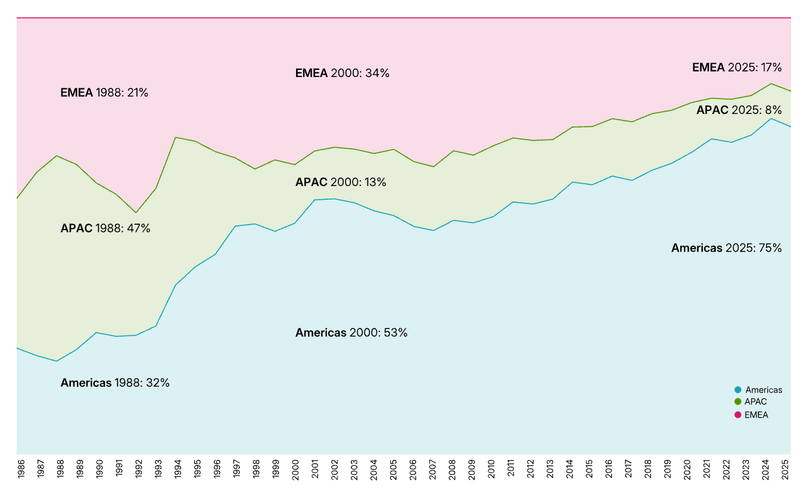
The message is clear – since the 1980s, North America, and specifically the US, has become ever more important to this index. In the broader ACWI index, the US represents 62.7% of the index’s total value, followed by Japan at 5.7% and the UK at 3.1%. Virtually every country in the ACWI index has seen its share decline over the last two years, except the US (up substantially), Israel, and the Netherlands.
So, has the US become ever more powerful in the most popular global equity index benchmarks? Indisputably, yes. But there’s another concentration risk worth discussing: the number of US companies that dominate an index.
The biggest are getting bigger
The next chart looks in more detail at the US benchmark index called the S&P 500. This S&P index, not MSCI, details which stocks dominate the US portion of the MSCI World. It measures concentration by looking at the top ten stocks and their market value as a proportion of the S&P 500 as a whole. Think of the Magnificent 7 plus some tech peers. Two facts stand out. The first is that these top stocks – nearly all of which are tech names you know – have become a major part of the total value of the US large-cap market and that concentration has grown steadily over recent years.
Yet another fact is obvious: we’ve been here before. In the sixties, a select group of really big names like Xerox, Amex and Coca-Cola, called the Nifty Fifty, dominated the S&P 500 index. Less spectacularly in the dot-com era, the top ten stocks – mostly tech names – also dominated the S&P 500 index, with names like JD Uniphase, Ciena and Oracle. So, US stock markets have dealt with concentration before and survived. Nevertheless, we shouldn’t be complacent about these risks. An interesting paper on the S&P index website a while back looked at the subsequent performance of the top ten stocks during the last peak of market concentration in the mid-60s. Its results were disturbing: “The aggregate performance of the June 1965 top 10 cohort was underwhelming. Three entered bankruptcy proceedings, all fell to represent much smaller weights, and several represent potential business school case studies in ‘what went wrong’ with once widely admired and dominant US corporations.”
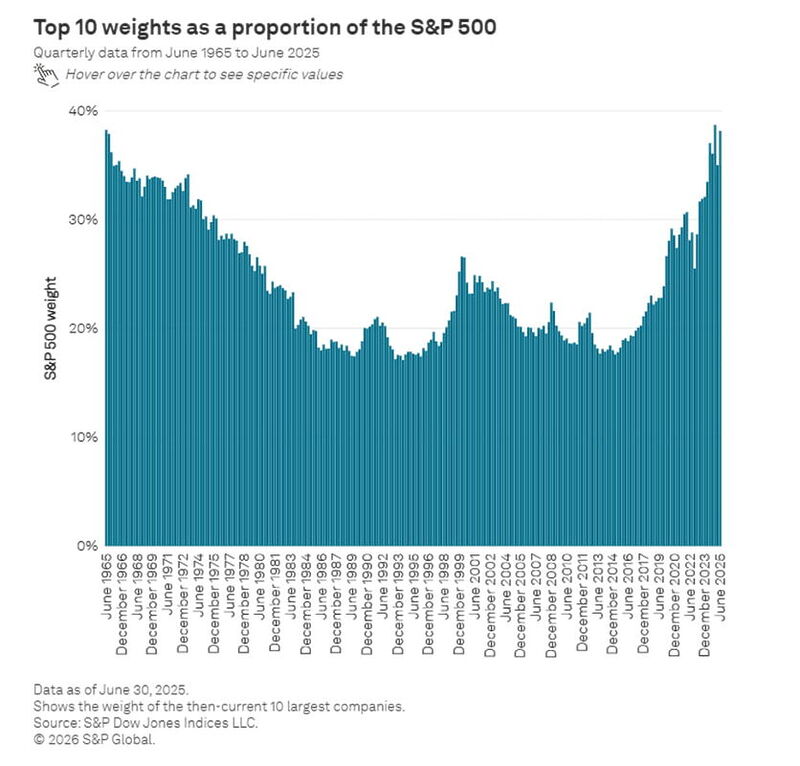
Yet this paper also makes an important point: if you’d held those top ten stocks and didn’t change your portfolio, you would have had a tough time. But that’s not what investors did – they largely bought a fund that invested across the 500 stocks in the index, and the top ten names from 1965 simply became less important as the S&P 500 continued to power ahead. Other top ten superstar names emerged, rotating out the older names.
As the report noted, “over longer periods, a changing of the guard among the cohort of the largest companies may initially be associated with a decrease in concentration (as the old guard falters to lower rankings), followed by an increase in concentration as the new entrants expand their footprint at the top.” The old top stocks faded away, to be replaced by a new cohort of top stocks. The old is replaced by the new and we all move on.
Too much of a bet on technology?
There is, though, another dimension to concentration risk – the sectors that dominate the index. Let’s look again at the MSCI ACWI index and shoot back in time to 2012, for instance. If we’d looked at this global index then, financials would have been the biggest sector at just under 20% of the index, while IT would have been number two at 13.1%. By 2026, that sector mix had changed dramatically. Financials were still important at 17% of the global equities index, but IT had jumped to 31.2%. No prizes for guessing why that might have happened – cue AI and the extraordinary profits being made by tech companies.
Here lies both the risk and the reward. The risk is by now obvious – AI valuations might be in a bubble, and the vast amounts of money being spent on data centres and AI chipsets might not generate a profit. It might also spark a financial crisis – and threaten humanity.
But the reality, as pointed out by Carrie King, CIO of U.S. and Developed Markets, Fundamental Equities, for fund management firm BlackRock, is “unlike past tech bubbles where valuations far outpaced fundamentals, the current concentration is heavily anchored by actual earnings power driven largely by the Artificial Intelligence (AI) infrastructure and tech ecosystem.” She points out that tech and select heavy hitters (such as Nvidia, Alphabet, and Amazon) have heavily skewed earnings growth. “For instance, recent quarters have seen overall S&P 500 year-over-year EPS growth rates surge past 25%–30% (with Q2 2026 reaching ~32%–37% inclusive of major gains like Alphabet’s investment revaluations), while the median S&P 500 company experiences much slower growth”. Sure, AI might be in a bubble, but no one is certain, and bubbles can last longer than everyone expects, experts and investment folk included.
The broader point is that although US stocks might be focused on a handful of tech sector names, the overall growth in earnings from these companies is extraordinary. According to the widely followed stock market analyst and commentator Ed Yardeni of Yardeni Research, analysts for the US market as a whole expect earnings per share for the 500 firms in the S&P 500 to rise to about $364 in 2026 and $419 in 2027, implying growth of roughly 15% in both years. According to Yardeni, “for now, the analysts are more bullish than we are about earnings prospects over the remainder of the decade. We are projecting $450 per share in 2028, $475 in 2029, and $500 in 2030”.
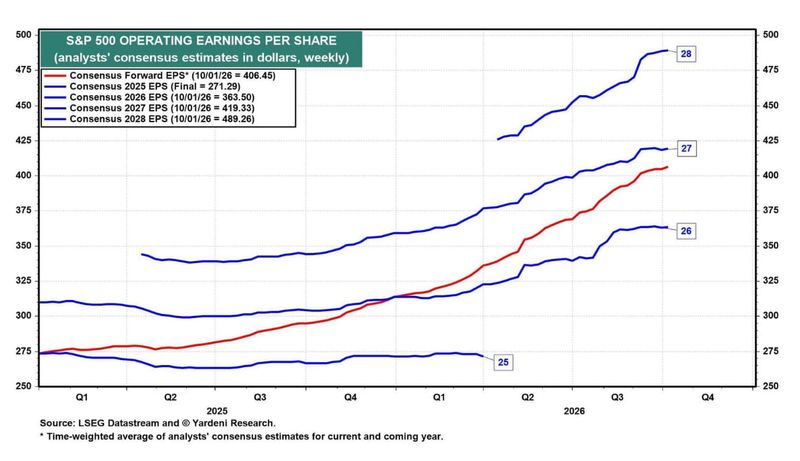
Yardeni reports that strong revenue growth expectations drive this extended earnings boom, while profit margins drive the earnings story. Analysts expect the S&P 500 profit margin to rise from 13.2% in 2025 to 15.7% this year, 16.8% in 2027, and a record 18.1% in 2028.
I’m spelling out these numbers to show how profitable and fast-growing US companies, mostly in the tech sector, are, and it comes down to one thing: it’s not just market hype, it’s hard numbers. Investors invest in these stocks because they are hugely profitable. You may believe these profits to be unsustainable in the long run, but that’s a matter of opinion.
More practically, the market doesn’t really care. If tech stumbles and profits fall, its share price will go down, and other sectors might see their share prices stay steady or even rise. Indices that power index tracking funds – ETFs – will simply rebalance and move on to the next brilliant stocks. In the immediate aftermath of that market reordering, there might be a big overall fall, but history suggests that at some point, usually months, sometimes years, the market regains positive momentum, and we all move on to the next exciting thing. Because indices make no moral judgment and only reward success, indices, ETFs, and investors are constantly churning to the next thing that will make money.
So, should you be aware of concentration risks, currently on US tech and AI stocks, yes. Should you worry about it? Maybe not if your time horizon for investing is many decades. Decades in which new and exciting things will emerge, and markets reward tomorrow’s successful Amazons and Nvidias. And in the meantime, the people behind the indices – the MSCIs, the S&Ps, and the FTSEs – just keep regularly rebalancing and checking that everyone is playing by the rules.
Managing volatility in an era of concentration risk
But there is a catch: that concentration can, every once in a while, result in volatility, i.e., market turbulence. That in itself is no bad thing, as volatility not only produces losses but also provides opportunity; i.e., you can buy what you like more cheaply. But volatility can destroy investors’ wealth, and if you don’t have many decades to ride out the market volatility, you may want a different risk profile.
Cue a more careful approach towards diversification. This could take many forms. You could choose to make sure you are diversified at the geographic level in equities, i.e. have fewer US stocks and more UK stocks, for instance. You could adjust your sector exposure and choose to overweight, say, financials or energy stocks or gold miners. You could also adopt a different approach to how you rank stocks.
Conventional indices like the MSCI World rank stocks by market capitalisation – so the most valuable company gets the biggest weight in the index. Alternative weighting systems exist; one of the most popular by far is to weight stocks by their dividend payout. More mature businesses with solid fundamentals tend to pay out more in dividends and those dividend payouts are themselves fairly stable every quarter or six months. Dividend-weighted equity indices and ETFs are popular amongst many more defensive, income-oriented investors. These dividend-income stocks have downsides, though: they tend to underperform the racier, growth-oriented tech names in a bull market, but for some older investors, that’s no bad thing.
The ultimate form of diversification is arguably the most obvious: don’t rely entirely on just one asset class, in this case global equities. Own some bonds, some cash, maybe some precious metals and other alternatives. This multi-asset approach to diversification has real value for all investors. An analysis a few decades ago by a big player in the auto-enrolment pensions space found that even investors in their mid-20s might want some bond exposure alongside their equities. The logic was elegant: for those who don’t know much about investing, a bad year of plunging equity valuations might put them off investing in equities for life. By this logic, it’s better to own some boring, less volatile bonds and build trust in stock markets over a few decades. For older investors, especially those approaching retirement, the attractions of less volatile assets other than US tech equities, like bonds, doesn’t need repeating.
Diversifying across asset classes isn’t hugely complicated, but for most investors, portfolio allocation and rebalancing is frankly a tad tiresome and time-consuming, which is why they go the managed or discretionary route: good advice on portfolio diversification is worth its weight in gold, even if it doesn’t always result in gold ending up in your portfolio mix.
Please remember that when investing, your capital is at risk. The value of your portfolio with Moneyfarm can go down as well as up and you may get back less than you invest. Past performance is not a reliable indicator of future performance. Tax treatment depends on your individual circumstances and may be subject to change in the future. The views expressed here should not be taken as a recommendation, tax advice or forecast. If you are unsure investing is the right choice for you, please seek financial advice.
*As with all investing, financial instruments involve inherent risks, including loss of capital, market fluctuations and liquidity risk. Past performance is no guarantee of future results. It is important to consider your risk tolerance and investment objectives before proceeding.