




This week we wanted to highlight some changes we recently made in some of our multi-asset portfolios. We slightly increased our equity exposure and generally reduced our short-dated bond positions.
At first glance, this might seem like a contrarian trade. There’s a lot of uncertainty in markets at present. Oil prices are high and that’s impacted gasoline and diesel prices around the world. Investors expect central banks to hike rates in the coming quarters. Geopolitical risk seems elevated, with the conflict in the Middle East still unresolved. Government bond yields have continued to rise, putting pressure on mortgage rates and government finances.
We are taking a more optimistic view and we think Artificial Intelligence (AI) has an important role here. We’ve seen strong demand as a result of AI spending across a range of industries and there’s an ongoing debate about whether it’s warranted and sustainable.
Our current view is that we are still relatively early in a phase of expansion and adoption, and that the strong demand we’ve seen for things like semiconductors, gas turbines and construction equipment can continue. Demand is outstripping supply in a number of AI value chain industries, with company order books in sectors like power supply fully committed for the next couple of years. As an example, the cost of renting older computer chips has risen sharply in recent months, reflecting limited supply. We’ve seen rapid adoption of AI tools across households and businesses. As the cost of token continues to fall, we observe an acceleration in demand, particularly with the growing adoption of AI agents. For all the strong growth we’ve seen, it could have been faster without these constraints.
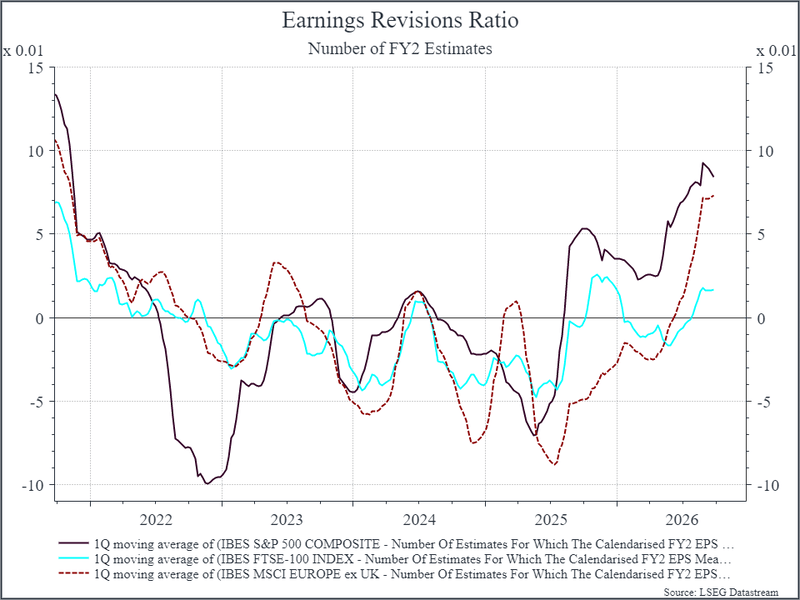
In this context, we see that expectations are not overly-exuberant and are moving higher. The chart below shows how many analysts are moving their earnings forecasts higher versus lower. Over the past couple of months, we’ve seen more upgrades than downgrades across the US, Europe and even the UK.
Looking at equity valuations, we think that the key point of focus at the moment should be less on the headline valuation and more on the earnings forecasts. For instance, the chart below shows the historical Forward Price/Earnings ratio for Emerging Market equities. It shows the lowest headline valuations in a decade. We think it highlights a couple of points. First, that earnings growth has been strong in Emerging Markets, particularly in the tech space. Second, that investors are not generally extrapolating that strong growth far into the future. They see these earnings as cyclical and expect some normalisation over time.
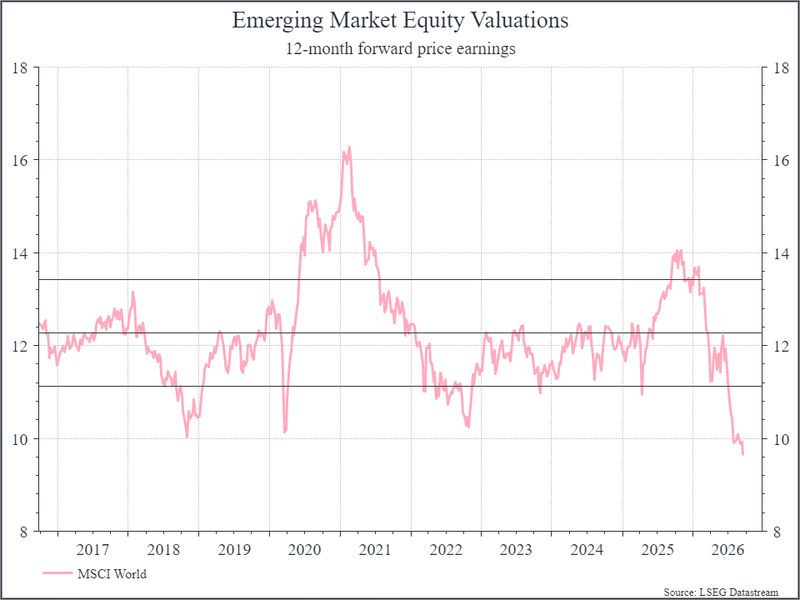
We think that’s a reassuring perspective. It suggests that investors haven’t forgotten that these are cyclical businesses and are mindful of past periods of over-enthusiasm. But if the cycle does last longer than many believe, we think earnings over the next couple of years could prove stronger than what’s embedded in these estimates.
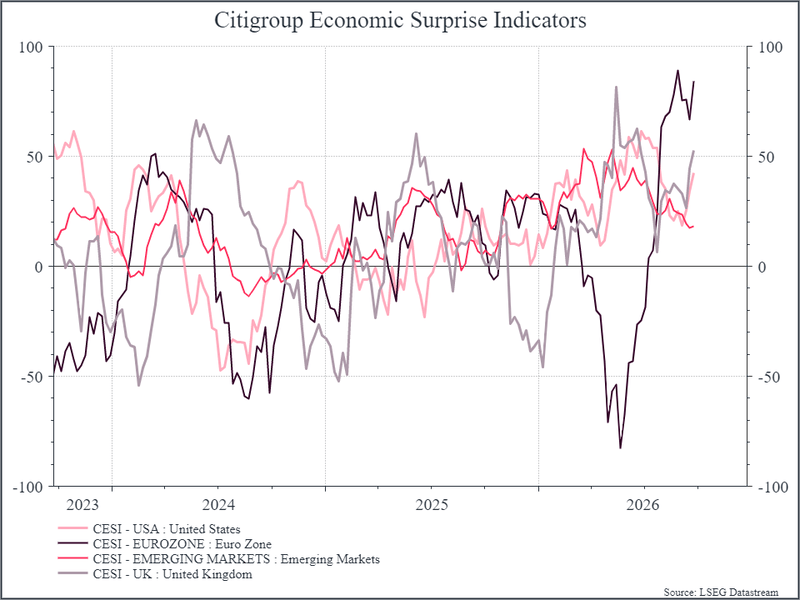
In terms of the macro outlook, the global economy has generally held up better than expected, despite the geopolitical headwinds. We think AI spending has had a lot to do with that. The chart below shows an index of economic surprises. It measures how actual economic data has compared with the forecasts from a range of economists. At present, macro data across the US, Europe and Emerging Markets is generally coming in better than expected.
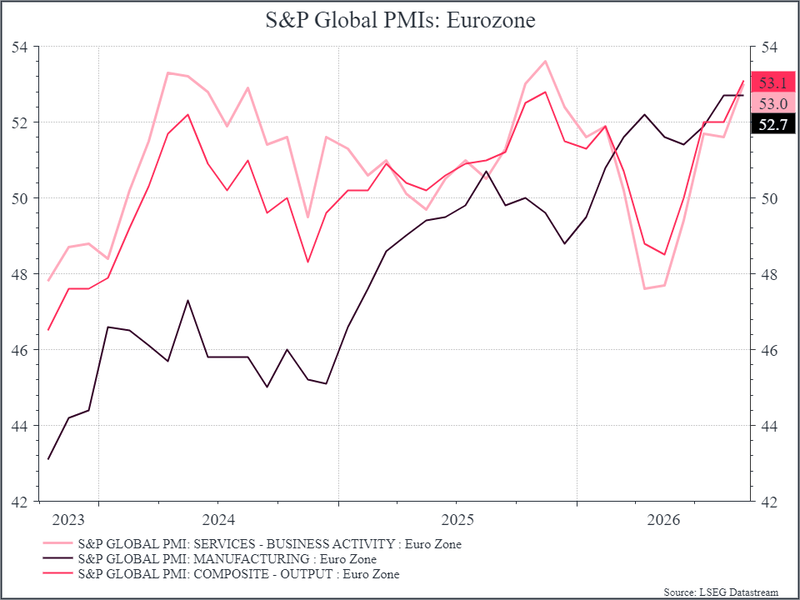
Drilling down a bit deeper, we can see that Purchasing Manager surveys (so-called PMIs) have also held up well. The chart below shows PMIs for the Eurozone – with a reading above 50 generally signalling a growing economy. The recent data looks pretty healthy even in Europe, generally regarded as having weaker growth. PMIs in the US showed a similar picture.
A couple of final points. First, we manage diversified portfolios and continue to look for a broad range of exposures across different asset classes.
Second, we remain mindful of the risks and the alternative scenarios. The outlook for the global economy is still uncertain, and higher energy prices or interest rates could weigh on demand. AI may also prove to be less transformative than the optimists expect, with fewer benefits and higher costs. We are therefore monitoring a clear set of variables – from energy prices and interest rates to the trajectory of earnings and AI investment – that could change our view.
For now, however, we remain constructive on markets and the outlook for earnings growth in the short to medium term, and that’s what has prompted us to increase our equity exposure.
*As with all investing, financial instruments involve inherent risks, including loss of capital, market fluctuations and liquidity risk. Past performance is no guarantee of future results. It is important to consider your risk tolerance and investment objectives before proceeding.