





We live in a society where news is much more accessible than it used to be. This is generally a good thing, however this news can also be a big driver in people’s decision making, particularly when it comes to money.
Money is something that comes with a lot of emotion, particularly savings. People work hard for their savings and investments and it’s not just a number on a screen, it’s a path to a better retirement, a new house or just general better financial wellbeing. So, often, people acutely follow what is going on, trying to understand what it means for their money.
But with a high volume of news always swirling around, is this a good thing?
What’s in the news?
Very helpfully, the Federal Reserve Bank of San Francisco has developed an index, the Daily news sentiment index, which assesses the sentiment, positive or negative, across the 25 major news outlets (admittedly of the United States, however I think we can safely assume the tone was the same on our side of the pond) and gives a score between +1 and -1 for the day, ranking the positivity or negativity of the sentiment about economics and markets.
To show an example, here is the monthly average over the last 10 years (since January 2016 to be precise):
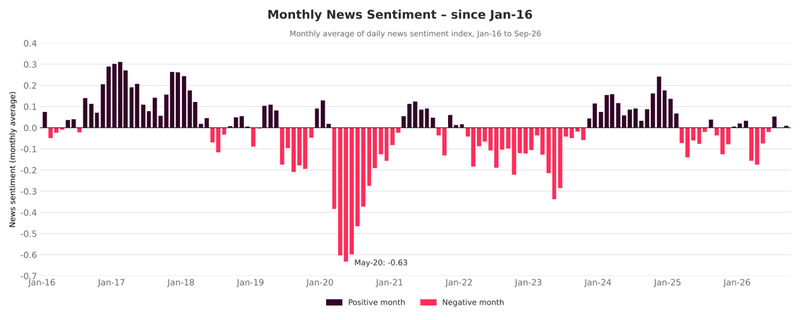
Over a long period of time, sometimes there’s positive news, sometimes there’s negative news, as you would expect.
However, what is striking, is if we look at the period since 2020, the picture looks very different:
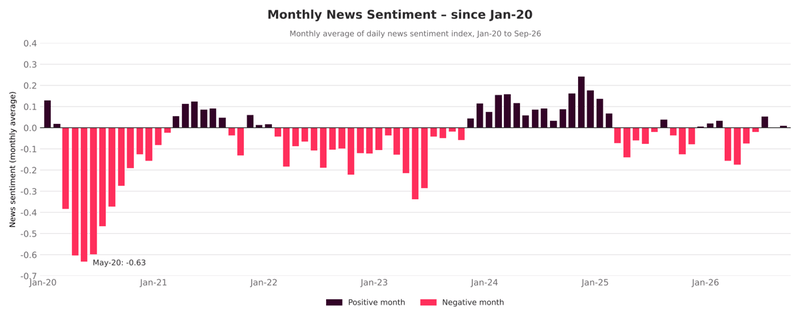
Whether this is due to a structural change of the media landscape or something else, I will leave you to speculate, but it’s clear to see that the vast majority of news has been negative over the last (nearly) 7 years.
Most interesting is the consistency of negative news since the beginning of 2025.
How has this matched to market performance?
I have used our P6 portfolio as a proxy for financial markets as it it gives a multi-asset view, but with a risk on sentiment:
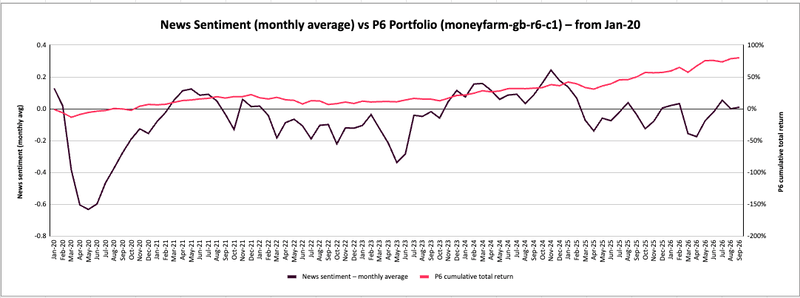
Here you can see that, despite most months reporting negative news (line below 0), the portfolio (market proxy) has continued upwards. It’s not a straight line of course, there is (and always will be) some volatility along the way.
To show this in a more pronounced way, here is the daily new sentiment as a cumulative number which reflects both the direction but also the momentum of the news sentiment:
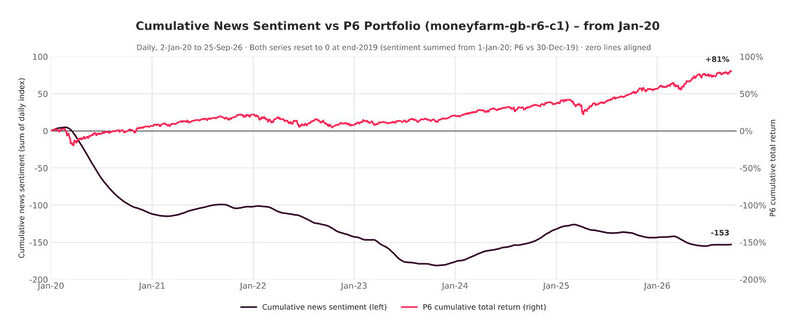
And for the more sceptical amongst you, below is the same chart but removing 2020 Covid news, which was understandably negative, although arguably a perfect example of what we are talking about given the market reaction:
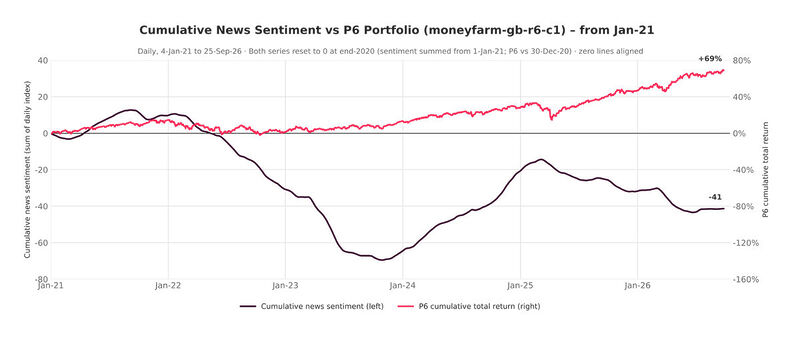
The story is still the same, negative news sentiment, but positive market performance.
Again, the most striking part is the big divergence since the start of 2025, although there are many periods where the news is negative and performance is positive.
What does this mean for investors?
As mentioned at the beginning, people are often looking to the news for guidance about what is going to happen to their money. Negative news (often incessant as shown by the direction charts) can really take its toll on people’s confidence. This doesn’t always translate to investments being liquidated, but it may lead someone to perhaps not continue investing for their future, perhaps “this part will go into cash for now until things improve”.
This is perfectly understandable. Behavioural biases, particularly loss aversion, are well documented. People don’t like the idea of losing money. So negative news can often drive defensive decision making.
But whilst defending against downside risk feels more prudent, actually missing out on opportunities and not letting your money grow to its full potential can arguably be more detrimental in the long run.
Below I have picked out a handful (among many) of the most relevant negative news months, mostly because of the ‘size’ of the negativity. There will no doubt have been people in that month who decided not to invest, given the swirl of negativity around them. But here (again using P6 portfolio as a proxy for general investing) we look at the impact of the decision not to invest:
| Month | News sentiment (monthly avg) | Missed P6 performance to latest date | Annualised missed performance |
| Mar-20 | -0.38 | +108% | +11.9% |
| Apr-20 | -0.60 | +98% | +11.2% |
| May-20 | -0.63 | +91.3% | +10.8% |
| Jun-20 | -0.60 | +87.4% | +10.6% |
| Oct-22 | -0.22 | +66.8% | +13.9% |
| May-23 | -0.34 | +62.6% | +15.7% |
| Apr-25 | -0.14 | +37.9% | +25.3% |
| Mar-26 | -0.16 | +14.7% | +31% |
The numbers speak for themselves. Obviously the 2020 months are a well trodden conversation path about lessons learned, but the reason that I included four was to show that, whilst March was actually the bottom of the market, the main negativity came later whilst markets were actually really rallying.
The more recent ones reflect that, despite a high volume of negative news in 2025 and 2026, markets have looked right through this and delivered very strong performance.
Sadly, I am not able to promise that markets will always go up, but history shows that things are often not as bad as the media is making out, at least in terms of markets and economics. I have referenced the period since 2025 a few times as this has really been a period in which the news has been consistently negative, yet markets have been incredibly resilient and positive.
There is a lot of negative news around Artificial Intelligence, for example, which is capturing the imagination most in this period. But the lessons of history show that this shouldn’t deter investors from continuing to invest in their future and stick to their investment plans.
Bad news sells newspapers, but be careful letting it inform your investment decisions.
Please remember that when investing, your capital is at risk. The value of your portfolio with Moneyfarm can go down as well as up and you may get back less than you invest. Past performance is not a reliable indicator of future performance. Tax treatment depends on your individual circumstances and may be subject to change in the future. The views expressed here should not be taken as a recommendation, tax advice or forecast. If you are unsure investing is the right choice for you, please seek financial advice.
*As with all investing, financial instruments involve inherent risks, including loss of capital, market fluctuations and liquidity risk. Past performance is no guarantee of future results. It is important to consider your risk tolerance and investment objectives before proceeding.