




In recent months, bond markets have experienced a period of significant volatility. Rising government bond yields across several advanced economies, driven by interest rate expectations, inflationary pressures and concerns about public finances, have led to a fall in bond prices.
In the UK, these pressures have become particularly relevant. The Bank of England has raised its base rate to 4%, marking its first increase in more than three years, as inflationary pressures persist, partly driven by higher energy costs. Changes in interest rate expectations can have a direct impact on bond markets, pushing yields higher and bond prices lower.
For fixed-income investors, this may seem paradoxical: why do bond prices fall just as yields rise? To understand this, it is important to distinguish between what happens to a bond’s price in the short term and the return it can generate over time.
This distinction matters because, in fixed income, prices react immediately to changes in interest rates, while returns accumulate gradually. That is why assessing a bond investment requires looking not only at market fluctuations but also at the investment time horizon.
How bonds work when interest rates rise
Bonds are financial instruments through which governments and companies raise funding from investors. In return, they generally commit to repaying the principal at a predetermined maturity date and, in the meantime, to making any coupon payments due.
During their lifetime, however, bonds can be bought and sold on the market at prices that differ from their redemption value. Their value also changes in response to interest rates and the yields demanded by the market.
The mechanism is relatively straightforward:
When interest rates rise, existing bond prices tend to fall. New bonds offer higher yields, making existing bonds less attractive, all else being equal.
When interest rates fall, existing bond prices tend to rise. Existing bonds pay higher coupons than new ones, so they become more attractive.
This means that a rise in interest rates can have two different effects on the same portfolio: an immediate fall in its value, but also an improvement in the return opportunities available from that point onwards.
These are two effects of the same phenomenon, but they occur over different time frames: the fall in value is immediate, while the benefit of higher yields accumulates over time.
Returns accumulate over time, while price changes happen immediately
To understand this dynamic, it is useful to distinguish between two components of a bond investment’s return.
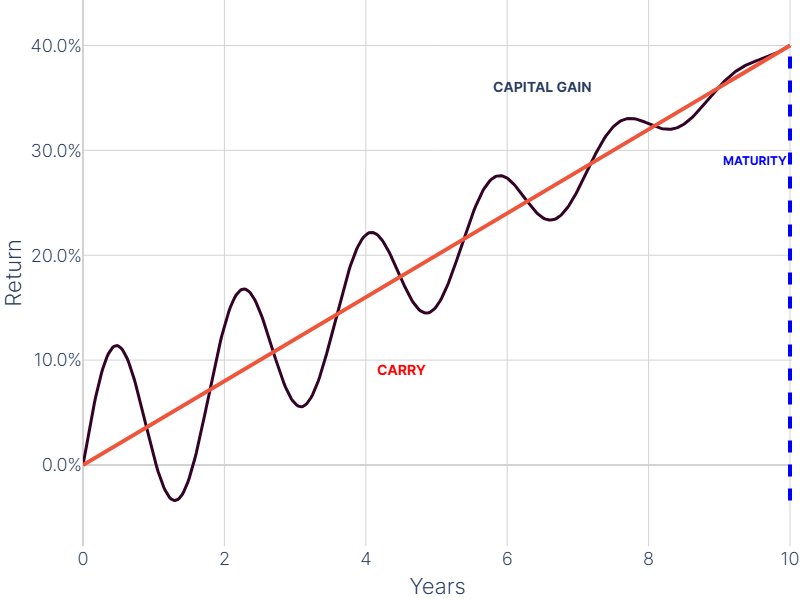
The first is carry: the return that a bond investment gradually accumulates over time, mainly through the coupons paid by the bonds in the portfolio and the difference between their purchase price and redemption value. In practice, it is a contribution to returns that builds up day by day, although the actual outcome depends on market conditions.
The second is the change in bond prices, which can happen much more quickly. When yields rise, for example, the value of bonds in a portfolio can fall in a single trading session, while the carry generated by the investments continues to accumulate gradually.
An example helps illustrate the difference. With an annual yield of 4%, carry amounts to approximately 0.011% per day, before costs. If yields rise by 10 basis points, a bond with a duration of 1 loses around 0.10% in a single day, roughly nine days of carry. For a 10-year bond, with a duration of around 8, the same move means a fall of close to 0.8%, more than two months of carry.
Duration is a measure that helps assess how sensitive a bond’s price is to changes in yields. Duration increases with maturity and decreases as coupon payments increase: the higher the duration, the greater the sensitivity. This relationship is only approximate, because prices are also affected by other factors and their response can vary depending on how yields change.
The key point is that the return on a bond investment does not necessarily develop in a straight line. Price fluctuations can be visible immediately, while the income generated by the bonds accumulates gradually. To assess the overall result, it is therefore important to consider both components and give carry time to do its work.
Why the investment time horizon matters
If you look at a bond portfolio day by day or week by week, price movements can have a significant impact on its valuation. Looking over a longer time horizon, however, gives the return accrued and the effects of bonds approaching maturity more time to contribute to the outcome.
When a bond is repaid as scheduled at maturity, the holder receives the principal due, generally equal to its face value. As maturity approaches, the market price therefore tends to move towards the redemption value, regardless of the purchase price. This process, known as pull to par, can help offset the effects of previous price movements over time.
Of course, this does not mean that every temporary loss will always be recovered within a set period. The outcome depends on factors such as the issuer’s creditworthiness, the purchase price, the initial yield, changes in interest rates and whether coupons are reinvested. A bond can also suffer permanent losses if the issuer is unable to repay it.
As a general rule, it is important to assess performance over a period that is broadly aligned with the recommended investment horizon and takes the characteristics of the portfolio into account.
This is particularly important when interest rates rise. Existing bonds in a portfolio may lose value, but new investments and reinvested coupons can benefit from higher yields. As a result, a portfolio that is currently showing a decline may have better return prospects than it did before rates rose, although this does not guarantee a recovery or a positive outcome.
Enhanced Yield: how to interpret the portfolio’s performance
These mechanisms also help explain the performance of Enhanced Yield, one of the two portfolios in our Smart Yield investment style. It invests in a selection of actively managed bond funds in institutional share classes, combining a relatively low risk profile with professional management.
Enhanced Yield aims to deliver the target return of the Bank of England base rate plus 1% a year (before service management fees and tax, and net of the costs of the underlying instruments) over a recommended investment horizon of one to three years, while keeping risk as low as possible. This target return is not guaranteed: the portfolio is not risk-free, and its value can fluctuate even over the short term.
To seek a return above that available from cash, the portfolio takes limited and controlled risks through actively managed bond funds. The investment approach considers factors including credit risk, sensitivity to interest rates, relative pricing between similar bonds and positioning along the yield curve. The aim is to combine these opportunities in an effort to achieve the target return with the lowest possible level of risk.
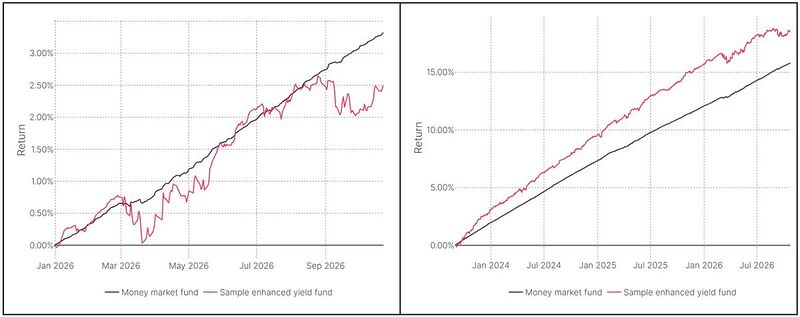
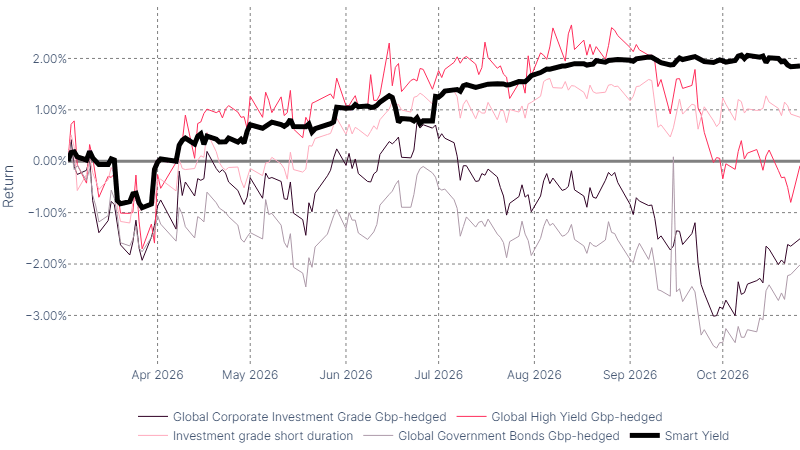
During the first few months following its launch, despite an exceptionally difficult period for bond markets, the portfolio maintained a positive return, limiting the impact of falling prices. It has not yet achieved its target of the Bank of England base rate plus 1% a year. This is a normal phase when considered in the context of the recommended investment horizon of one to three years.
The chart below shows Enhanced Yield’s performance since launch (black line) compared with bond returns across major market indices. While most indices are significantly down (with global bonds down by around 2%), Enhanced Yield is already in positive territory. This reflects its controlled risk profile and portfolio construction, which combines complementary active strategies and benefits from diversification.
Three main factors have influenced performance:
The impact of interest rates: when market yields rise sharply, bond prices fall. The actively managed funds selected for Enhanced Yield maintain very low sensitivity to interest rates (duration) by investing in shorter-maturity bonds. This has helped significantly limit the impact of falling prices and maintain a positive return, even during a very difficult period for bonds.
The steady contribution of carry: coupon income accrues day by day. Over time, this continuous stream of income helps offset price fluctuations and contributes to moving the portfolio towards its target return.
Initial transaction costs: when a portfolio is built and securities are purchased, there is a small implicit cost arising from the difference between the buying and selling prices, known as the bid-ask spread. This is a technical market cost incurred only once, when the portfolio is first established, and it is gradually absorbed over the following months through the return generated by the investment.
Higher yields have also improved the opportunities available for new investments and for reinvesting coupons.
It is therefore important to distinguish between the return achieved so far and the return expected from this point onwards. The former reflects what happened during a specific period of market conditions; the latter takes account of current conditions and the return opportunities available for the future. These are two different measures and cannot be compared directly without considering the investment time horizon.
A practical example helps illustrate this difference. At launch, Enhanced Yield’s target return was around 4.7% a year. Today, following the rise in interest rates, it has increased to 5.02%*. However, as explained above, this is an estimate based on current market conditions, not a guarantee of returns.
Assessing performance over the appropriate time horizon
In fixed income, looking at short-term fluctuations without considering the return accrued and the duration of the investment can provide an incomplete picture. A rise in yields can temporarily weigh on a portfolio’s value while also increasing the potential return available from bonds purchased from that point onwards.
Performance should therefore be assessed in light of the investment objective, the characteristics of the bonds in the portfolio and the time horizon for which the strategy was designed. For Enhanced Yield, the recommended investment horizon is one to three years: this allows performance to be assessed over a period more consistent with the product’s objective, although it does not eliminate the risk of losses.
The principle to remember is simple: in fixed income, the price reflects what the market is valuing today; the investment time horizon helps explain how returns can contribute to the outcome over time.
*Target return based on the DPM objective and adherent to the underlying mutual funds mandate over the recommended one-to-three-year time horizon, as at 16 October 2026.
Please remember that when investing, your capital is at risk. The value of your portfolio with Moneyfarm can go down as well as up and you may get back less than you invest. Past performance is not a reliable indicator of future performance. Tax treatment depends on your individual circumstances and may be subject to change in the future. The views expressed here should not be taken as a recommendation, tax advice or forecast. If you are unsure investing is the right choice for you, please seek financial advice.
*As with all investing, financial instruments involve inherent risks, including loss of capital, market fluctuations and liquidity risk. Past performance is no guarantee of future results. It is important to consider your risk tolerance and investment objectives before proceeding.