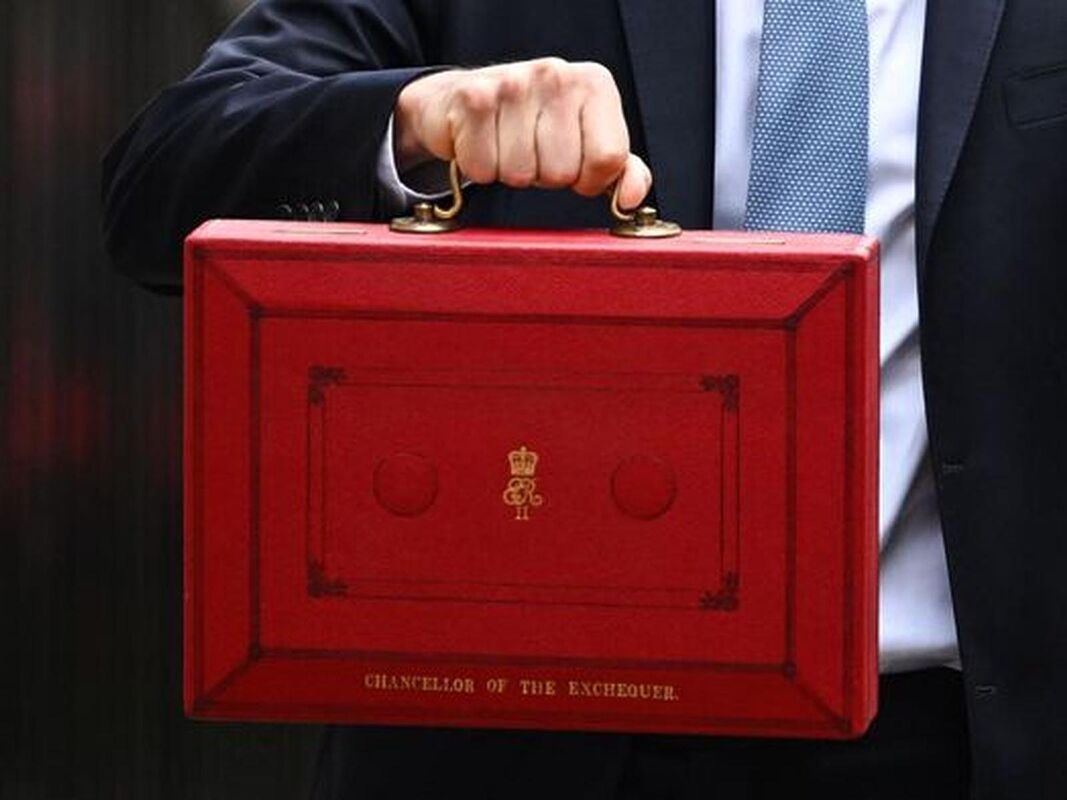




The Autumn Budget lands on Wednesday 28 October 2026 and as usual the weeks before it have been full of headlines about what might change. Speculation is not policy, though. What you can control today is whether you are using the allowances that already exist.
In this article we walk through the main tax allowances available to UK investors in the 2026/27 tax year: Individual Savings Accounts (ISAs), pensions, Junior ISAs and the allowances that apply to a General Investment Account (GIA). For each, we set out how it works today, what has already been confirmed for the future, and what has been speculated ahead of the Budget.
ISAs: your £20,000 annual allowance
Every UK adult resident can put up to £20,000 into ISAs in the 2026/27 tax year, which runs to 5 April 2027. Any growth, interest or dividends earned inside an ISA are free of UK income tax and capital gains tax, and you don’t need to declare them on a tax return.
A few things worth knowing:
It’s use it or lose it: unused allowance does not carry forward to the next tax year.
You can split it: the £20,000 can be spread across Stocks & Shares, Cash, Lifetime and Innovative Finance ISAs.
Timing matters: investing earlier in the tax year gives your money longer to potentially grow tax-free, although markets can fall as well as rise.
What’s already confirmed
From 6 April 2027, savers under 65 will only be able to put up to £12,000 a year into Cash ISAs. The overall £20,000 allowance stays the same, so the remaining £8,000 can go into other ISA types such as a Stocks & Shares ISA. Savers aged 65 and over keep the full £20,000 cash limit.
What’s been speculated
Reports in September suggested a new first-time buyer ISA could be announced, possibly replacing the Lifetime ISA and removing its under-40 age limit. Nothing has been confirmed.
We have not seen credible reports of a change to the headline £20,000 allowance, but nothing is certain until the Chancellor speaks.
Pensions: tax relief and the annual allowance
Pensions remain one of the most tax-efficient ways to save for retirement. Contributions receive tax relief at your marginal rate of income tax, so a £100 contribution costs a basic-rate taxpayer £80, and higher and additional-rate taxpayers can claim back more through Self Assessment.
Annual allowance: up to £60,000 a year, or 100% of your relevant UK earnings if lower.
Carry forward: you may be able to use unused annual allowance from the previous three tax years, provided you were a member of a registered pension scheme in those years.
Tapered allowance: if your adjusted income is above £260,000 (and threshold income above £200,000), your allowance can fall to as little as £10,000.
Money Purchase Annual Allowance (MPAA): once you start flexibly drawing from a defined contribution pension, the amount you can pay in with tax relief generally drops to £10,000 a year.
Tax-free cash: most people can take 25% of their pension tax-free, up to a lifetime Lump Sum Allowance of £268,275.
Access age: you can currently access private pensions from 55, rising to 57 from April 2028.
Pension contributions can also reduce your taxable income. That matters if your income sits near a threshold, such as £100,000, where the personal allowance starts to be withdrawn.
What’s already confirmed
Inheritance tax on pensions: from 6 April 2027, most unused pension funds and death benefits will count towards your estate for inheritance tax purposes.
Salary sacrifice: from April 2029, National Insurance relief on pension contributions made through salary sacrifice will only apply to the first £2,000 a year.
Frozen thresholds: income tax thresholds are frozen until 5 April 2031, so more people may drift into higher tax bands over time.
Why pensions still stand out, even with the inheritance tax change
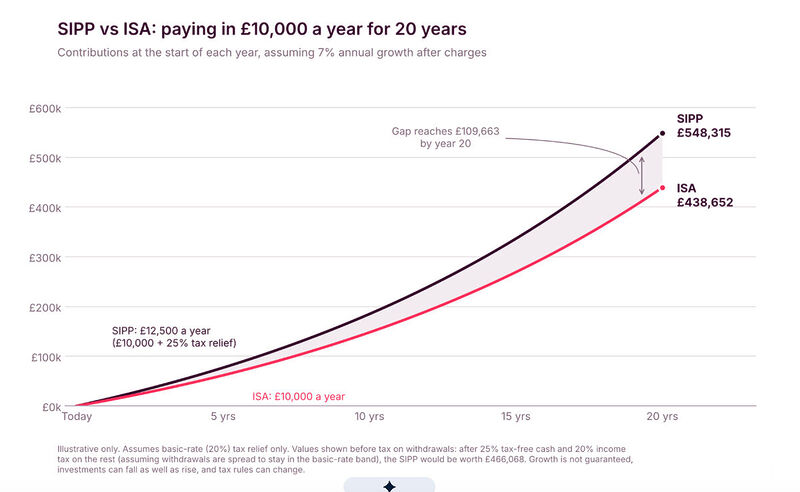
The inheritance tax change has led some people to ask whether pensions are still worth it. For most people saving for their own retirement, the answer is yes. The reason is simple. With a pension, the money that would have gone to the taxman as income tax is invested for you as well. More money invested from day one means more money that can grow and compound over time.
An example
John wants to put £10,000 a year aside for 20 years. He can do one of two things:
Put it in an ISA: £10,000 a year is invested.
Pay it into a Self-invested personal pension (SIPP): the government adds 25% basic-rate tax relief, so £12,500 a year is invested.
Assume both grow at 7% a year after charges for 20 years:
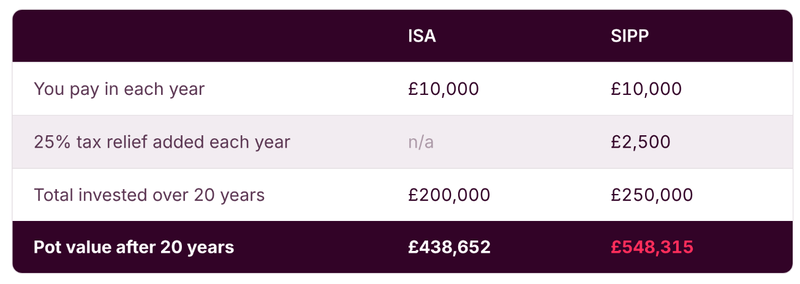
After 20 years, assuming 7% growth a year, John’s SIPP is worth £109,663 more than his ISA. Unlike the ISA, he’ll pay income tax on most of what he takes from his pension.
Paying a higher rate of tax?
If you pay income tax at more than 20%, a pension can be even more valuable. The 25% top-up only covers basic-rate relief, but higher and additional-rate taxpayers can claim back the extra through their Self Assessment tax return or by contacting HMRC.
Higher-rate taxpayers (40%) can claim back a further 20%. On John’s £10,000 a year, that’s an extra £2,500 back each year, so each £12,500 in his SIPP costs him £7,500.
Additional-rate taxpayers (45%) can claim back a further 25%. That’s £3,125 a year, so each £12,500 in his SIPP costs him £6,875.
If John were a higher-rate taxpayer and invested his £2,500 a year rebate in his ISA, it could grow to around £109,663 over 20 years at the same 7%. That’s on top of the figures in the table.
You can only claim the extra relief on income you’ve paid higher or additional-rate tax on, and it isn’t added automatically, so it’s worth checking you’ve claimed it.
What about inheritance tax?
ISAs have always counted towards your estate for inheritance tax. From April 2027, pensions will be treated in a similar way, so the change brings them closer to ISAs rather than putting them behind. If John died with both pots untouched and inheritance tax applied at 40%, his SIPP would leave £328,989 compared with £263,191 from the ISA. Pensions left to a spouse or civil partner will generally remain free of inheritance tax. Beneficiaries may also pay income tax on inherited pensions if the person dies after age 75, so it’s worth getting advice if passing on wealth is a priority.
This example is for illustration only. It ignores National Insurance and charges beyond those built into the growth rate. Investment growth is not guaranteed, the value of investments can fall as well as rise, and tax rules can change.
What’s been speculated
Tax-free cash: there has been talk of cutting the tax-free lump sum, with one figure mentioned being £100,000. Similar rumours came up before the 2024 and 2025 Budgets and tax-free cash was largely left alone both times.
State pension: reports suggest the triple lock could be kept until 2030 and then reviewed.
It’s worth being cautious about acting on rumours. Before a previous Budget, some people withdrew tax-free cash early because of speculation that never came true, leaving money outside a pension wrapper that they could not put back.
Junior ISAs: £9,000 a year for children
A Junior ISA (JISA) lets parents, grandparents and others put up to £9,000 a year in total into a tax-efficient account for a child under 18. This is separate from your own £20,000 ISA allowance.
- Growth and income inside a JISA are free of UK tax.
- The money belongs to the child. They can take control of the account at 16 but cannot withdraw until they turn 18.
- At 18, the JISA becomes an adult ISA in their name.
- Like the adult ISA, the allowance resets each tax year and does not carry forward.
For families, a JISA can sit alongside your own ISA and pension as part of a wider plan, for example to help with university costs or a first home.
What’s been speculated
We haven’t seen specific speculation about Junior ISAs ahead of this Budget, and the £9,000 limit has been unchanged since 2020.
General Investment Accounts: capital gains and dividend tax
A General Investment Account (GIA) has no contribution limit, which makes it useful once your ISA and pension allowances are used. The trade-off is that gains and income can be taxable, so two allowances matter here.
Capital gains tax (CGT)
Annual exempt amount: the first £3,000 of gains you make in a tax year is tax-free.
Rates: gains above that are taxed at 18% for basic-rate taxpayers and 24% for higher and additional-rate taxpayers.
Like ISAs, the exempt amount can’t be carried forward.
Dividend tax
Dividend allowance: the first £500 of dividends each year is tax-free.
Rates (from April 2026): 10.75% for basic-rate taxpayers (up from 8.75%), 35.75% for higher-rate (up from 33.75%) and 39.35% for additional-rate taxpayers.
What’s been speculated
CGT rates: CGT is widely reported as a leading option for raising revenue. One proposal would bring CGT rates in line with income tax rates (20%, 40% and 45%), possibly phased in over several years.
CGT on death: there has been discussion of removing the ‘uplift’ that resets gains on death, which could leave beneficiaries facing CGT on long-held assets.
Dividends: some commentators have suggested further increases to dividend rates or a smaller dividend allowance.
None of these measures has been confirmed.
Making sense of it all
Budget speculation can make it tempting to act quickly. In practice, most tax changes announced at a Budget take effect from the following 6 April and changes are only confirmed on Budget day. Decisions that can’t be undone, such as taking pension tax-free cash early, deserve particular care.
A calmer approach is to focus on what’s within your control:
- Check how much of your £20,000 ISA allowance you’ve used this tax year.
- Review your pension contributions and whether carry forward could apply to you.
- Consider whether a Junior ISA has a place in your family’s plans.
- If you hold investments in a GIA, look at whether your CGT and dividend allowances are being used.
As always, it’s important to remember that these are just rumours and speculation. The media often present such possibilities in ways that can pressure individuals into making hasty financial decisions, potentially undermining sound long-term plans.
Knee-jerk reactions in the short term based on speculation can have unintended consequences later on. The most effective strategy is to stick to your long-term financial plan.
Our team of Wealth Managers is staying up to date on all Budget developments and is available to help you cut through the noise.
Join us live on Budget night to find out what’s changed for your tax, your pension and your portfolio.
Live webinar: Wednesday, 28th October at 6pm
Please remember that when investing, your capital is at risk. The value of your portfolio with Moneyfarm can go down as well as up and you may get back less than you invest. Past performance is not a reliable indicator of future performance. Tax treatment depends on your individual circumstances and may be subject to change in the future. The views expressed here should not be taken as a recommendation, tax advice or forecast. If you are unsure investing is the right choice for you, please seek financial advice.
*As with all investing, financial instruments involve inherent risks, including loss of capital, market fluctuations and liquidity risk. Past performance is no guarantee of future results. It is important to consider your risk tolerance and investment objectives before proceeding.