





By mid-August, Bitcoin looked like an asset nobody wanted. It was trading at around $63,500, about 49% below its October 2025 peak, after ten months of decline. Thirty-day realised volatility had fallen to an annualised 27%, far below its long-term average, while direct Bitcoin trading volumes were among the lowest on record. Trading was thin and volatility unusually low. Investors were paying up to protect against further falls rather than betting on a rebound, and some long-standing holders were selling.
That positioning explains the violence of what came next. In four sessions from 17 August, Bitcoin went from about $62,800 to a high of $79,241. Roughly $3 billion of short positions were liquidated across crypto, around $1.7 billion of them in bitcoin. The key detail is that open interest – the total value of outstanding positions in Bitcoin derivatives – fell by almost 9% during the move. The rise was driven by investors who had bet against Bitcoin being forced to close their positions, rather than by new bets made with borrowed money. At the same time, genuine demand emerged from investors buying Bitcoin directly. US spot bitcoin ETFs took in $517 million on 19 August and $606 million the next day, then posted nine straight days of inflows to 27 August.
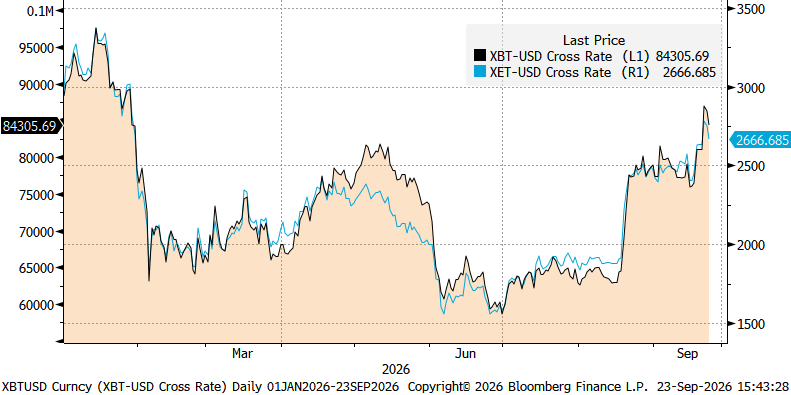
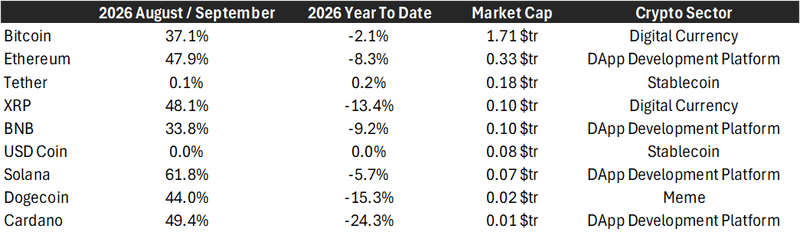
Within crypto, the rebound followed the usual pattern: it began with Bitcoin and then spread to more volatile cryptocurrencies, which recorded even larger gains. Ether rose about a third in August and outpaced bitcoin. Solana gained around 61.8% by late September, with August being its first positive month after ten consecutive declines. XRP was up more than 45% over the month to late September.
The macro moment
The macro conditions also helped. The macro backdrop is an inflation problem the Federal Reserve (Fed) now owns. Summer inflationary prints provided little clarity, keeping risks decidedly biased to the upside. Fed staff attributed the pressure to tariffs, higher energy costs from the Middle East conflict and the AI capex boom.
At its July monetary policy meeting (FOMC), the Fed kept interest rates unchanged at 3.50–3.75%, but three members (Hammack, Kashkari and Logan) dissented in favour of a hike. Meanwhile 10- and 30-year Treasury yields reached roughly twenty-year highs, with the 30-year above 5.25%.
Speaking at Jackson Hole on 28 August, Chair Warsh called interest rates the Fed’s “predominant tool” and said it must be confident inflation is moving to target “clearly and at sufficient speed. Otherwise, we have work to do.”
On 16 September the Fed delivered its first hike in more than three years, 25bp to 3.75–4.00%, unanimously, with projections pointing to one more. Bitcoin barely moved, edging from about $75,400 to $76,300, because the hike had been largely priced for two weeks.
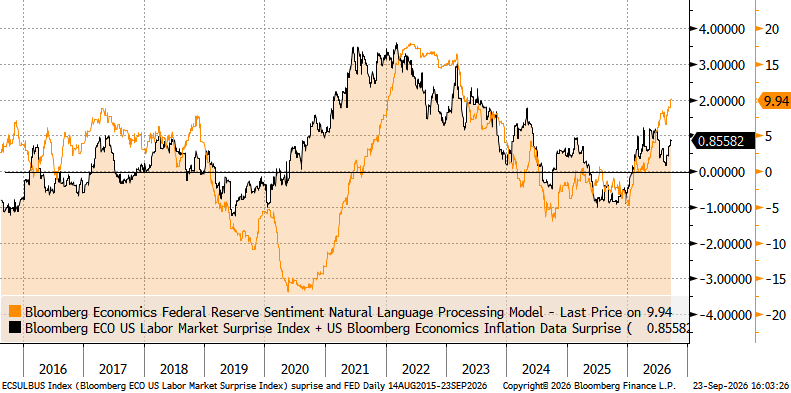
Fed communications have turned distinctly more hawkish than at any point since 2023, edging steadily upward even as employment figures and price pressures only partially warrant the shift. The chart below illustrates the tone of public FOMC statements alongside macroeconomic surprises in labor and inflation. The relationship typically holds, with central bankers leaning hawkish during periods of tight employment and elevated inflation; but the latest surge in hawkish rhetoric stands out sharply.
The Fed is only half of the story. The most interesting variable is the interaction between the Fed and the Treasury, not the Fed alone. On 19 August, Treasury said it would at least double its buybacks of 10–30-year bonds, from $2 billion to $4 billion per operation, between 9 September and 4 November. Secretary Bessent said yields “do not reflect underlying fundamentals” and pointed to a broader toolkit. Crypto reacted at once: the announcement coincided with the start of the ETF inflow run. The result is an unusual policy mix. The Fed is tightening at the short end, and Warsh has signalled that balance-sheet expansion is unlikely except as a one-off response to market failure. The Treasury, meanwhile, is trying to cap the long end with its own tools.
Asset correlations further underline this backdrop. Bitcoin’s co-movement with gold has surged to year-to-date highs, whereas its link to the US dollar remains skewed to the downside. Meanwhile, the relationship with expected Federal Reserve policy shifts has inverted; fewer anticipated rate reductions now serve as a constructive signal for bitcoin. Together, these dynamics reinforce a positive response function to growing macroeconomic anxieties surrounding the US fiscal balance.
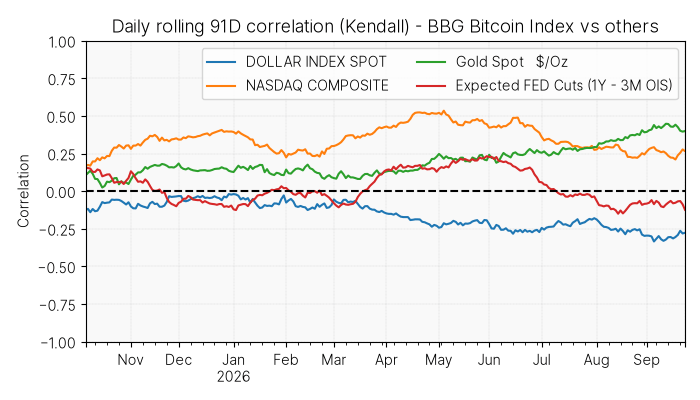
The customary caveat applies: macroeconomic drivers capture only a fraction of bitcoin’s trajectory, given that overarching co-movement measures stay subdued. As a result, factors specific to Bitcoin continue to drive much of its market performance.
On the regulatory side, the legislative route has closed for this year. When the Senate returned from recess, the CLARITY market-structure bill came to a procedural vote on 15 September and failed cloture 50-49, well short of the 60 votes needed. Negotiations ran right up to the vote. Republicans had released a revised 630-page text that took in some Democratic provisions, but many Democrats still judged the ethics language on officials’ personal crypto interests, including the President’s, to be too weak. The stablecoin-yield dispute between banks and crypto platforms was never fully settled either.
The failure matters more for the medium term than for this month’s prices. Without a statute, the US framework rests on agency action. That includes the SEC–CFTC joint interpretation from March, which says most crypto assets are not securities, the SEC’s proposed Regulation Crypto Assets offering regime, and continued ETF approvals. Both agencies have said they will keep going without Congress. Agency rules can move faster than legislation, but they are less durable, because a future administration can rewrite them far more easily than it can repeal a law. With control of Congress likely to be split after November, the next realistic window is the new Congress, and consequences for digital asset prices are uncertain.
The flows
As highlighted earlier, capital flows shifted sharply into positive territory throughout August, establishing the month as the strongest for US allocations since January. European investors similarly displayed renewed appetite, although aggregate volumes within the region continue to represent a minor fraction of overall activity.
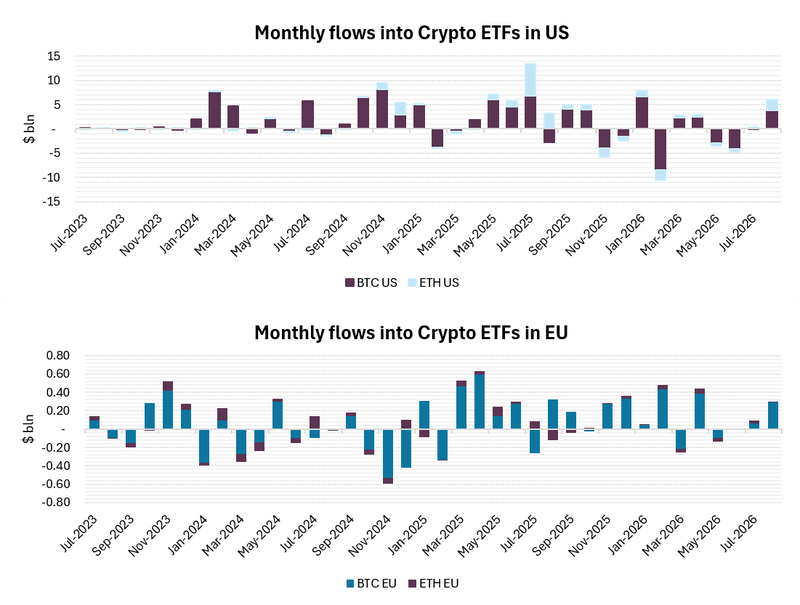
Taken together, the period illustrates a sharp shift where suppressed positioning intersected with macroeconomic catalysts, namely Treasury intervention and dollar softness, helped by genuine spot inflows through ETFs rather than speculative leverage.
While it is too early to call this a lasting shift, crypto continues to be driven largely by its own market dynamics. Bitcoin continues to function as a largely uncorrelated asset at a time when macro risk concentrates heavily in the equity market’s ongoing reliance on the Artificial Intelligence trade, providing a compelling vector for portfolio construction.
Investing in Crypto involves a high level of risk. You should not invest unless you are prepared to lose all of the money you invest. The value of your Moneyfarm portfolio can go down as well as up, and you may get back less than you invest. You may not be protected if something goes wrong. Past performance is not a reliable indicator of future results. The views expressed here do not constitute a recommendation, advice or forecast. If you are unsure whether investing is right for you, please seek independent financial advice.
*As with all investing, financial instruments involve inherent risks, including loss of capital, market fluctuations and liquidity risk. Past performance is no guarantee of future results. It is important to consider your risk tolerance and investment objectives before proceeding.