





Government bond yields have moved relentlessly higher this year, and the striking feature of that move is how little it seems to care about the economic backdrop. Whatever the data, whatever the signal on growth, the direction of travel has remained remarkably consistent. Last week captured that paradox perfectly: encouraging inflation data, with a softer-than-expected Consumer Price Index (CPI) followed by a subdued Producer Price Index (PPI), gave US Treasuries a strong week of gains, only for those gains to reverse on Friday after weaker activity data. It was a telling sequence. With markets now firmly anchored in their view of monetary policy, even a run of favourable economic data struggled to sustain the rally.
The forces behind higher yields are multiple and deeply interconnected: inflation, central banks, fiscal policy and, increasingly, Artificial Intelligence (AI). Viewed from one angle, rising bond yields are simply another expression of the broader AI investment story.
Where are yields?
To understand today’s market, it helps to step back. The reopening of the global economy after Covid, followed by the war in Ukraine, marked a genuine regime change for interest rates, pulling bond yields out of the low-rate environment that had defined the decade after the Global Financial Crisis. For a while, it seemed yields had found a new equilibrium. Then the conflict in Iran and the resulting energy shock pushed them higher once again.
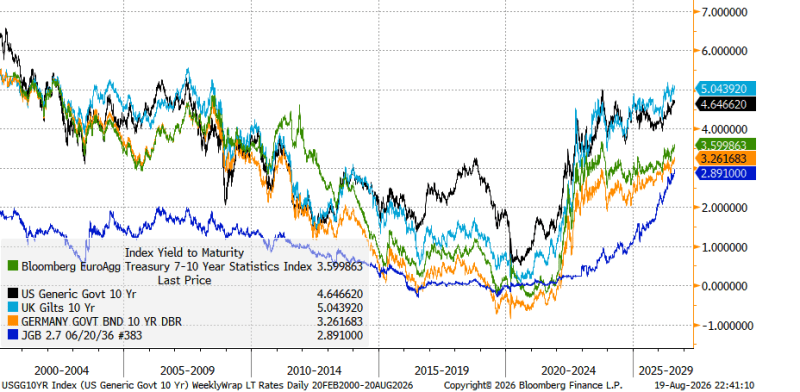
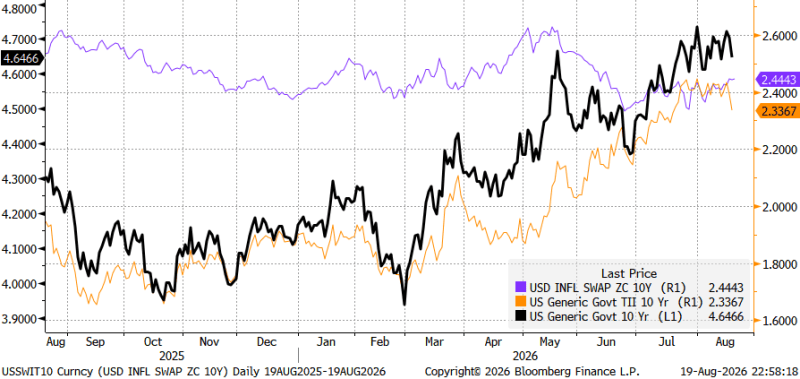
More interestingly, however, 2026 has proved more nuanced than it first appears. While inflation concerns have undoubtedly returned, the rise in yields has been driven overwhelmingly by a repricing of real interest rates, rather than higher inflation expectations. We typically break government bond yields into two components: expected inflation and the real yield, which reflects monetary policy, economic growth and the underlying cost of capital.
As the chart below shows, almost all of this year’s increase has come from the real component. That tells us a great deal about the environment investors are navigating. Long-dated US real yields now stand close to 3%, their highest level in nearly twenty years, even though inflation breakeven rates have remained relatively contained despite the rise in energy prices.
Central banks are maintaining a hawkish stance
Part of this reflects the tone adopted by central banks. The conflict with Iran has not translated directly into higher inflation expectations, but it has affected bond yields through the policy channel. Central banks remain determined to prevent inflation from becoming entrenched, and markets have priced in that vigilance.
Using machine learning techniques, we monitor the language used by central banks around the world. As the chart below illustrates, their communication has become noticeably more hawkish since late 2025.
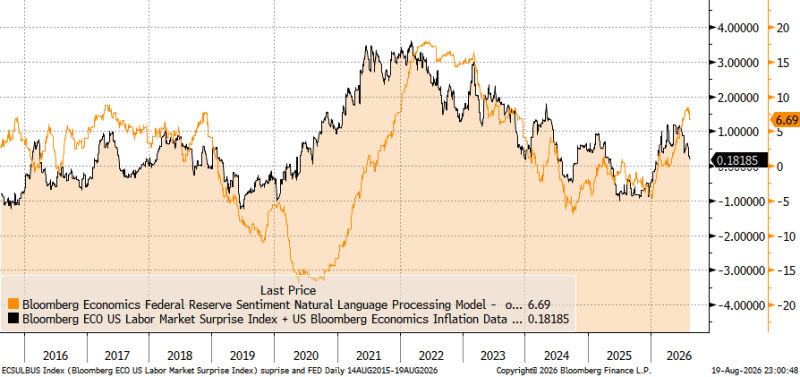
Interestingly, this closely mirrors economic surprise indices – in other words, whether inflation and labour market data have come in stronger or weaker than economists expected. Inflation surprises remained consistently positive during the first half of 2026, although they have moderated more recently. That may begin to support a more constructive outlook, both for central bank rhetoric and, eventually, for the path of bond yields.
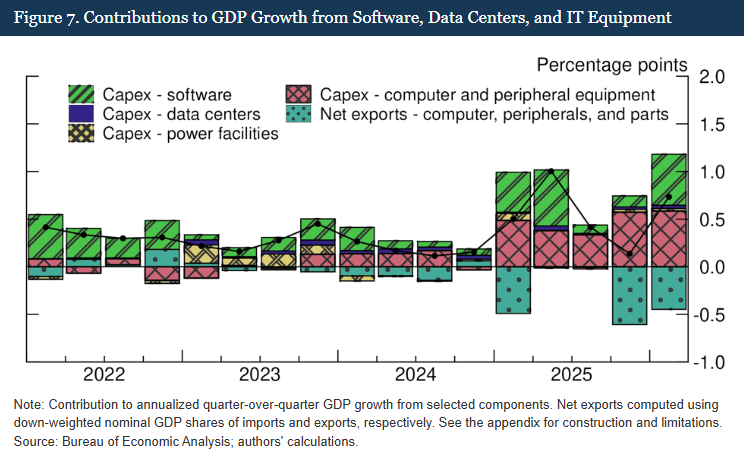
It is also worth recognising that higher yields partly reflect stronger underlying growth, particularly through the AI investment cycle. Investment linked to Artificial Intelligence is now making a meaningful contribution to both the level and the growth rate of Gross Domestic Product (GDP). Stronger growth has historically been associated with higher real interest rates, and today’s bond market appears no different.
Is the government being crowded out?
One of the most fascinating developments this year is whether the extraordinary wave of AI-related corporate borrowing – led by the hyperscalers, but certainly not limited to them – is beginning to compete directly with governments for investor capital. The evidence is becoming increasingly compelling.
Traditionally, crowding out describes a situation in which excessive government borrowing absorbs savings that would otherwise finance the private sector, pushing borrowing costs higher across the economy. Today’s dynamic looks almost reversed. Massive corporate debt issuance, particularly from the technology sector, is contributing to higher borrowing costs for governments themselves.
The same pension funds and insurance companies that finance sovereign deficits are now being asked to absorb an unprecedented supply of long-dated corporate bonds. As that supply grows, investors naturally demand higher yields. Bank of America estimates that corporate and mortgage issuance together have added around 0.3 percentage points to the US 10-year Treasury yield this year alone.
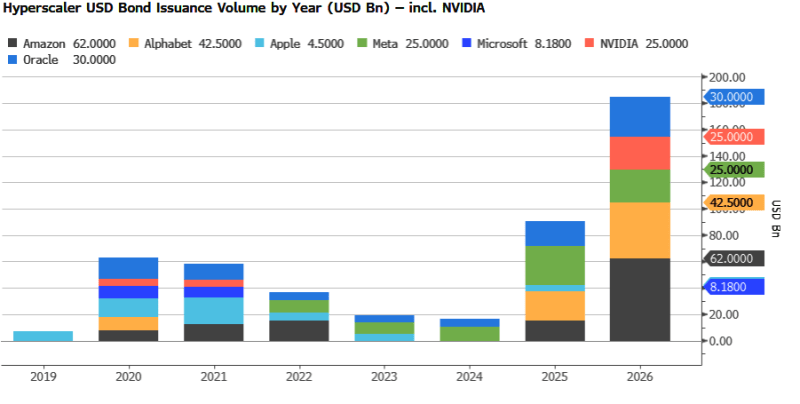
The scale of issuance is remarkable. By early July, Amazon, Alphabet, Meta and Oracle had issued around $194 billion of bonds, roughly 80% more than during the whole of 2025. Goldman Sachs expects the five largest hyperscalers – including Microsoft – to issue around $250 billion this year, rising towards $400 billion by 2027. For context, these companies issued an average of just $28 billion annually during the five years preceding 2025.
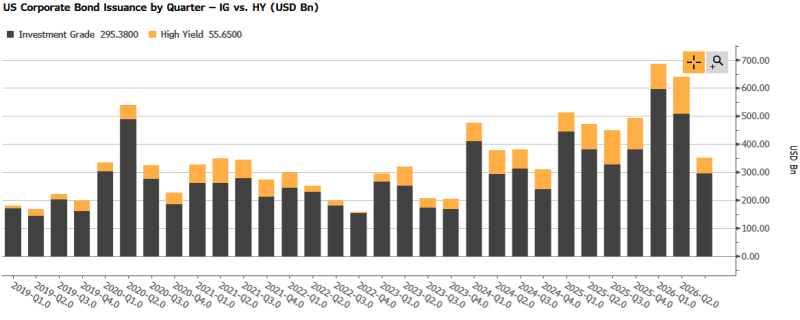
Nor is this purely a technology story. Issuance of investment-grade corporate debt has reached exceptionally high levels across the wider corporate sector. The chart below shows quarterly issuance of US dollar-denominated investment-grade and high yield bonds. The first half of 2026 has already broken previous records, with total issuance on course to approach $2.5 trillion for the year. That represents an enormous volume of high-quality debt competing for the same pool of investor capital – and increasingly competing directly with US Treasuries.
Fiscal pressure
The final piece of the puzzle is the fiscal position of developed economies. Since Covid, government finances have become noticeably more fragile. Budget deficits have widened across much of the developed world, including countries that were once viewed as models of fiscal discipline.
Germany has loosened fiscal policy to finance higher defence and infrastructure spending, pushing Bund yields back to levels last seen in 2011. In the United States, the federal deficit is approaching $2 trillion, an extraordinary figure outside periods of crisis. In the United Kingdom, thirty-year gilt yields have moved towards 6%, their highest level since the late 1990s, as investors focus on the sustainability of public finances ahead of the autumn Budget. France faces similar pressure, with long-dated yields at their highest since 2008 amid persistent political difficulties in delivering fiscal consolidation.
Against the backdrop of an exceptionally capital-intensive AI investment cycle, this fiscal deterioration matters even more. Investors are simultaneously being asked to finance record levels of corporate investment and increasingly indebted governments, while many of the traditional buyers of long-duration bonds – from the Federal Reserve to Japanese institutions – have become less active. It is the combination of these structural forces, rather than any single factor, that explains why long-dated bond yields have continued to rise despite mixed economic data.
The pressure on governments is undeniable, and it is in this light that we should read the US Treasury’s recent announcement that it will step up its buybacks of long-dated bonds in an effort to contain the cost of its own borrowing.
Staying conscious of the tide
Where does this leave investors? Above all, it calls for humility. There will undoubtedly be periods when bonds appear oversold, and economic data may occasionally justify a tactical decline in yields, as last week’s inflation and employment figures briefly suggested. Yet throughout 2026, buying long-duration bonds has largely meant swimming against a powerful structural tide.
The recent moderation in both inflation and labour market data may strengthen the case for lower yields over time, and we are watching closely for signs that the improving tone of central bank communication begins to translate into the bond market itself. We will continue to monitor these drivers carefully – particularly the stance of central banks – and adjust portfolios accordingly.
Ultimately, identifying the turning point, if and when it arrives, is likely to be one of the defining challenges for fixed income investors in the years ahead.
*As with all investing, financial instruments involve inherent risks, including loss of capital, market fluctuations and liquidity risk. Past performance is no guarantee of future results. It is important to consider your risk tolerance and investment objectives before proceeding.