





Longer lives don’t always mean healthier ones. Rising healthcare and care costs are changing the way investors should think about retirement planning and long-term wealth. Our special contributor and Daily Telegraph’s columnist David Stevenson explores more.
We all know the meta-narrative of our era by now, and no, I’m not talking about Artificial Intelligence but aging. We’re all living longer, and that increases the financial pressure on us to accumulate capital. But the simple fact of living longer is a good news story, isn’t it? Maybe, but there’s a catch. Are we living longer, healthier lives? To which the answer in the UK may be no. The rate of longevity improvement has stalled dramatically since around 2011, and healthy life expectancy has actually fallen in recent years.
Male healthy life expectancy at age 50–54 fell from 19.9 years to 19.4 years between 2015 and 2025. Female healthy life expectancy at the same age fell from 21.1 years to 20.6 years. In England, women are now expected to spend a smaller proportion of their lives in good health than they did in 2011–2013.
Age UK’s 2025 State of Health and Care report put it bluntly: “We are living fewer years in good health”. Two-thirds (68%) of people aged over 80 are now living with two or more long-term conditions such as diabetes, arthritis, or heart disease. About 2 million people aged 65+ have unmet care needs.
Given these numbers, it’s no surprise that more 50- and 60-somethings are turning up at gyms, cycling in tight-fitting Lycra shorts, eating healthier, and, perhaps more importantly, making sure they are healthier by investing in personal medical insurance (PMI). Given that the NHS seems to be in a perma-crisis – although waiting lists are actually going down in aggregate – the option of making sure you are tip-top healthy via regular medical screenings, private GPs and hip replacement operations has become increasingly popular. But as with all the good things in life – red wine, carbon fiber bikes and avocados – this all comes at a cost.
Rocketing health insurance costs
A record 6.2 million people in the UK now have access to private medical insurance, with the LaingBuisson Health Cover report valuing the total UK health cover market at £8.64 billion by the start of 2025, reflecting an extraordinary 13.83% year-on-year growth. For context, the PMI market was worth around £4.83 billion as recently as 2022. That’s the market essentially doubling in a matter of years. The number of people covered by employer-provided PMI hit 4.7 million in 2023, the highest figure in more than 30 years of data collection, with a 7% overall uptick in both individual and workplace policies.
The price is obvious – increasing premiums as insurers and health care providers, increasingly busy, try to ration demand via price. Willis Towers Watson’s Global Medical Trends Survey found that UK private medical inflation was expected to hit 12.6% in 2024 – higher than the global average of 10.4% and more than three percentage points above the European average. Insurer Aon’s equivalent research was even more alarming, forecasting a medical trend rate of 15% for the UK in 2024. By 2025-26, WTW’s updated survey put UK healthcare inflation at 10.6% for the year, with 10% projected for 2026 – still among the highest in Western Europe.
The average cost of private health insurance for a single adult in the UK now sits at around £79.59 a month, with couples paying approximately £145.77 per month and a family of four shelling out around £166.52 monthly in 2026. A decade ago, those figures would have been closer to half that for many policyholders. Bupa’s indicative pricing suggests a non-smoking 25-year-old outside London pays around £50 a month, while a family with two adults in their 50s and two teenagers might pay around £220 a month – and that figure is rising every renewal cycle.
UK Private Medical Insurance: Key Market Metrics, 2004–2024
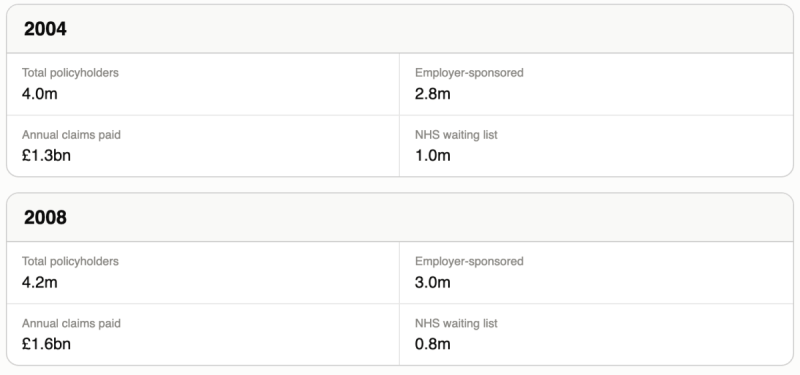
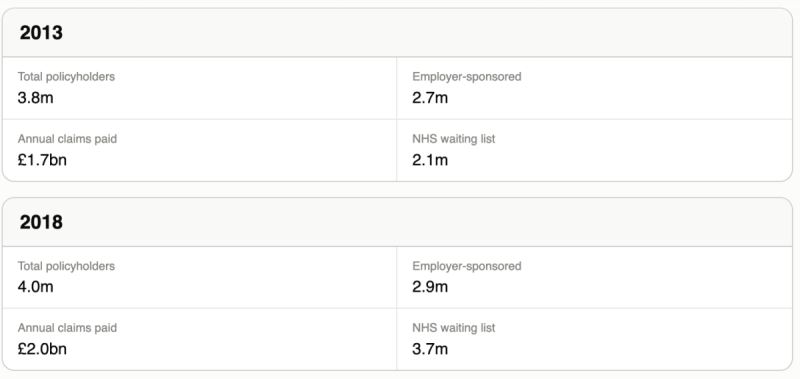
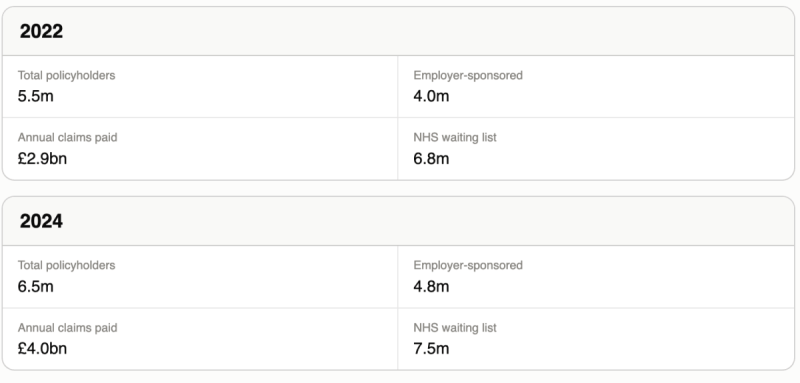
It would, of course, be easy to blame these rising costs on rampant profiteering by increasingly profitable healthcare providers and insurers, but that wouldn’t really be very accurate. The rapid increase in demand can’t be easily managed by a sudden increase in capacity – it takes years to build new hospitals and train competent, experienced medical staff. And whatever resources private healthcare businesses can deploy, they face a global challenge: healthcare inflation. By the first quarter of 2026 (versus a start date in 2015), the CPI for health products and services stood at 142.4, suggesting that health sector prices have risen by 42.4% since 2015, compared with overall price increases of roughly 35-36%. Healthcare inflation, in other words, has consistently outrun the general cost of living, even though the post-pandemic inflation spike that hit energy and food prices hardest.
Don’t forget care home costs
If the 50-, 60-, and 70-somethings are having a hard time paying for health insurance, pity their older peers in their mid-70s through to their 90s: they face a lottery with care home costs, with costs rising rapidly across the board, including for one-on-one home care.
UK care home costs have increased dramatically over the past two decades, from relatively modest but steady annual rises pre-2020 to double-digit surges in the post-pandemic era. The most authoritative annual dataset comes from LaingBuisson’s Care Homes for Older People report, which tracks weighted average weekly fees across the market.
The average weekly residential care home fee rose 19% in a single year from 2021-22 to 2022-23, compared to a headline CPI peak of 10.1% – care homes were roughly double the general inflation rate. By March 2025, Which magazine and LaingBuisson confirmed average fees had hit nearly £1,400 a week, a rise of more than a quarter since 2021-22 alone. One in seven independent nursing homes was charging over £1,800 a week for new residents by 2025. Three factors explain this sharp increase:
- labour costs (care homes are extremely staff-intensive and have been hit hard by National Living Wage increases and the employer NI rise in 2025),
- energy and food inflation,
- chronic underfunding of local authority rates that forces providers to push higher fees onto self-funders.
The King’s Fund notes that real-terms adult social care expenditure in 2023/24 was still only £4.6 billion more than in 2010/11 in real terms (remarkably little growth for 13 years) which tells you how much cost has been shouldered by individuals rather than the state.
To put the numbers in context: according to Which magazine, a self-funding resident in a standard residential care home now faces costs of roughly £70,000–£80,000 per year, rising to well over £90,000 in London and the South East. In 2005, a typical care home place cost around £20,000–£25,000 a year. That’s a near-tripling in nominal terms over 20 years, and a very significant real-terms increase even after adjusting for general inflation.
A plan of action?
I want to start with what many might consider a controversial statement: invest in a healthier lifestyle rather than conserve every last penny. Building on Seneca’s quote (Not how long, but how well you have lived is the main thing) and the wider Stoic and Epicurean traditions, it strikes me that if you reach your 60s, or even 70s, and are in good health, it’s worth investing to make sure you stay that way.
NHS waiting lists are steadily improving – really, they are, the hard data support that statement – but too many older folk resolutely refuse to spend money to get quicker treatment, even though they can afford it. Everyone is entitled to their views and politics, and clearly, we have all invested our taxes in the NHS and expect to get some payback, but I have lost count of the number of fairly comfortably well-off older folks who spend months in agony as they resolutely refuse to do anything other than wait their turn on the NHS list.
As I said, that is their prerogative, but it strikes me that an investment in private medical cover or, at the very least, private health services might be a sensible investment if you have the money (which many don’t). Until the left of the Labour Party abolishes private medicine – always a risk – it’s a free country, and spending money to keep you healthy is a great investment, arguably the greatest investment you can make. Unfortunately, it comes at a cost, which, as we have seen, is growing by the year. It’s not unreasonable to suppose that a couple in their 60s in decent health might be paying anything from £2 to £5k per annum for private medical cover.
Then there’s the risk that, as you hit your 70s and 80s, you might have to account for care home costs. Again, assuming the state will not underwrite your costs – more than likely, unless you live in Japan – it’s probably not unreasonable to assume you might need to keep anything between £50 and £200k as a reserve for the long term to fund those costs. You might be able to draw down some capital from home via equity release, but it’s best not to rely on that assumption.
So, from an investment perspective, where does this leave us? I would make three observations.
The first is that you might need more money than you pencilled into your wealth plan because of additional insurance costs or lump sums to cover care home costs.
That might prompt you to do one of two things: work later or stay invested in risky assets like equities longer, or even both. In many of my recent articles for Moneyfarm, I’ve noted that conventional asset allocation advice might no longer be quite fit for purpose. Traditional theory amongst financial planners argued that from your mid-50s, investors should dial down risk, do everything to conserve capital and then switch to de-accumulation (spend the money) by your mid-60s. This was predicated on actuarial data, which probably assumed retirement at 65 and living until 75, i.e., ten years of post-retirement. Those assumptions are no longer valid, and one could argue that the old, risk-reducing mid-50s have now become the mid-60s.
Given the costs of staying healthy longer and the increased longevity, more financial professionals suggest investing in riskier assets until you are older, and maybe not giving up work so early. This observation won’t work for everyone, and you should always seek professional advice, but I’d cordially suggest that taking on a bit more investment risk in your 60s might be worth exploring.
That leads me to the last suggestion: planning ahead for the care home hit. There’s a very decent chance you might never need to budget for care home costs, possibly because you’ve kept yourself healthy and addressed medical issues early on. You may not, though, be so lucky, and you may need, at the very least, to have a plan to pay for those costs – and relying on the local authority to pay for it does not constitute a plan. Again, this is where professional advice comes in handy, as they can walk you through various options, ranging from building buckets for different anticipated costs and associated investment strategies to less mainstream ideas like equity release. Every reader will have their own solution, but in all cases, by your late 60s, you need a plan.
I’ll finish with a more upbeat suggestion: why not capitalise on the trends I’ve discussed and build them into your investment strategy? By this, I mean considering investing in funds (or even stocks) that benefit from the durable, long-term trends I’ve discussed. Two ideas jump out: healthcare property funds and general healthcare funds. Healthcare property funds invest in everything from care homes for the elderly to GP surgeries. They are part of the wider infrastructure sector and tend to be income-oriented whilst also taking a conservative view of capital appreciation, in part by focusing on the quality of their property tenants and keeping leverage low.
More generally, there’s a growing number of funds that invest widely in an ageing society – across sectors from wealth management to healthcare – and, more specifically, in healthcare firms. That latter category tends to comprise two niches: much riskier biotechnology funds, which are better suited to really adventurous types, and lower-risk healthcare funds that invest in drug companies, hospitals and medical services firms. These funds haven’t shot the lights out compared with, say, AI and pure tech funds, but they do appeal to more defensive investors, especially if they pay out a decent income via dividends.
Please remember that when investing, your capital is at risk. The value of your portfolio with Moneyfarm can go down as well as up and you may get back less than you invest. Past performance is not a reliable indicator of future performance. The views expressed here should not be taken as a recommendation, advice or forecast. If you are unsure investing is the right choice for you, please seek financial advice.
*As with all investing, financial instruments involve inherent risks, including loss of capital, market fluctuations and liquidity risk. Past performance is no guarantee of future results. It is important to consider your risk tolerance and investment objectives before proceeding.