


Portfolio diversification is one of the key tenets of the Moneyfarm investment process. In fairness, these days it’s not a terribly original idea, which doesn’t mean it’s not worthwhile. The idea is that you have a bunch of distinct assets that behave differently from each other and that helps even out some of the highs and lows you can get in financial markets.
But the outcome isn’t guaranteed and one reason for that is that the relationship between different instruments can change. Assets you thought behaved differently from each other last year start to move the same way this year.
We’ve been thinking about correlations (the extent to which different asset classes move together) recently in the context of the Artificial Intelligence (AI) theme. When we think about our equity exposure, the simplest way to implement it would be just to buy an ETF based on a broad index, say the FTSE All World or MSCI World. There are also a lot of ETFs available when we want to take a more targeted exposure.
Many of our B2C portfolios have exposure to Emerging Market equities, the Nasdaq – a tech-heavy US index, and a Global Value ETF. We’ve made those choices rather than simply buying a broad global index, so when we monitor them, we often think about whether they’ve done better than the broad index. Currently, given the focus on technology equities, we also think about how closely these instruments are aligned with the global tech sector. We want to understand how correlated these different instruments are.
If you just look at how these instruments move, you don’t learn a great deal. They’re all global equities and so equity risk is the most important driver. When equities do well, these instruments will usually rise, and vice versa.
But if you dig a bit deeper, things get more interesting. In the chart below we look at how each of these exposures has done relative to Developed Market equities overall. We can see that historically, they’ve all behaved quite differently. For instance, when the Nasdaq has done well, sometimes Emerging Markets have underperformed. The black line shows the combined outcome (equally weighted), and it has been pretty close to a simple global equity universe over the past twenty years.
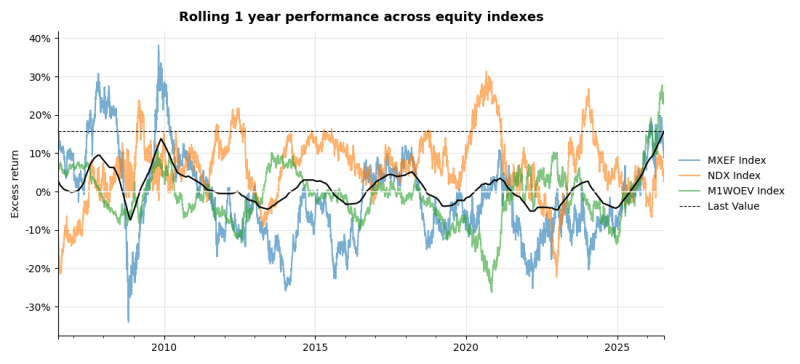
More recently, that seems to have changed. The right hand side of the chart shows that since early 2025, the combination of Nasdaq, Emerging Markets and Global Value has done better than a standard Global Equity Index. All three of them have been outperforming at the same time – and that’s quite unusual. In the past twenty years, we saw some outperformance in the recovery after the Global Financial Crisis, but even then, it was really driven by the outperformance of EM equities.
So, then we wanted to think about how much this was the result of the “AI theme”. The chart below aims to capture that. It’s a measure of how sensitive the performance of the three indices are compared with the global technology sector. As you’d expect the Nasdaq has historically been very exposed to the performance of global tech, while it’s been much lower, and often negative, for Emerging Markets and Global Value.
More recently, we’ve seen a real shift, as Emerging Markets and Global Value have become much more aligned with the global tech space. That partly reflects the increasing role of the big Taiwanese and Korean tech companies in Emerging Markets, and the strong performance of some previously unloved semiconductor and memory producers in the US.
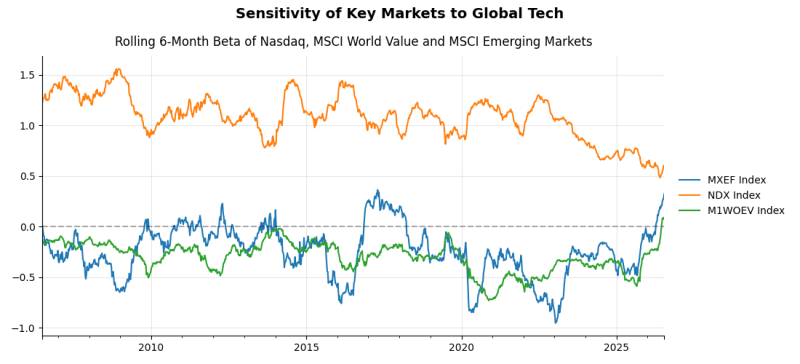
So where does this get us? We’ve owned these exposures for some time (Nasdaq, Global Value and Emerging Markets) and over the past year they’ve done pretty well. That’s good news. But their outperformance compared to global equities looks more correlated with technology than it was in the past – certainly for Emerging Markets and Global Value. That could mean the equity portion of our multi-asset portfolios is actually less diversified than was the case a year ago – at least looking at these numbers. That’s good news if tech continues to power ahead, but might be more challenging if sentiment on tech begins to waver.
How have we addressed this? The right answer, we think, is to look for exposures that provide more diversification. In the equity world, European equities and the UK in particular are good candidates – and we have exposure there. Intuitively that makes sense, they are less directly exposed to the technology sector and AI, although not completely immune. Outside of equities, the rise in bond yields has meant that global fixed income can continue to provide opportunities for diversification.
*As with all investing, financial instruments involve inherent risks, including loss of capital, market fluctuations and liquidity risk. Past performance is no guarantee of future results. It is important to consider your risk tolerance and investment objectives before proceeding.