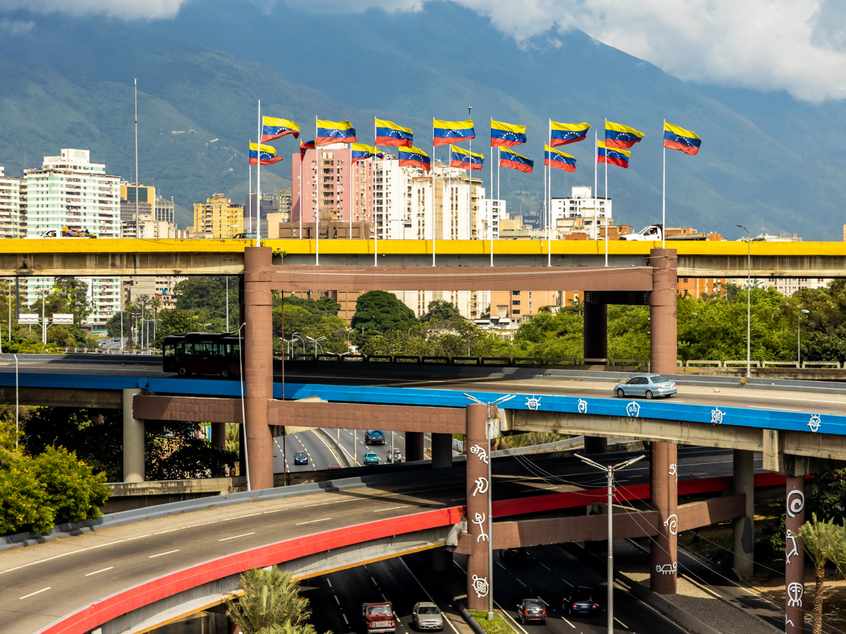



At the beginning of January, the US military captured Venezuelan President Nicolás Maduro and moved him to the US on charges of “narco-terrorism”. The US Department of Justice had indicted Maduro on those charges back in March 2020. We wanted to think about the implications of this move for financial markets.
We can look at this on three levels. First, the immediate impact on Venezuelan assets and our portfolios. Second, broader financial market implications. Third, potential longer-term geopolitical considerations.
On the first point, the direct impact on our portfolios was quite limited. Venezuelan financial assets are largely absent from global indices, even if Venezuelan bonds have generally rallied on the news. The Venezuelan economy has suffered significantly in recent years, and is far smaller than it was. Oil production has also fallen sharply in recent years, largely due to lack of investment. Venezuela now accounts for less than 1% of global production.
The overall market reaction was fairly muted. The oil price initially sold off briefly – on expectations that increased US investment into Venezuela could prompt higher production – but there’s no conviction about whether or when that could realistically happen.
Investor focus seems to be elsewhere – on the prospects for increased investment in Artificial Intelligence (AI) in 2026, the potential for lower policy rates and the outlook for robust growth, particularly in the US. And, at least in the first few days of the year, the outlook is generally positive. We think that there’s an underlying assumption here that the US won’t find itself committing significant resources in some sort of nation-building. That’s something that the President has specifically opposed in the past, as have many of his supporters.
The potential longer-term implications
Finally, there are the potential longer-term implications. Here you can create a number of potentially challenging scenarios. Firstly, could the US continue on this path – never mind past opposition? The President and his advisors put a number of countries on warning – notably Colombia, Cuba, Mexico and Greenland/Denmark. That might seem premature given the unclear outlook for Venezuela, but if the government in Caracas does fall into line on things like oil investment, perhaps the US administration will see this as an effective approach for dominating the Western hemisphere.
The second point is around geopolitics – notably around China and Russia. The argument goes that if the US is keen to dominate the Western hemisphere, perhaps that implies that it will leave other regions alone, raising for instance the risk of conflict between China and Taiwan.
At the same time, it was interesting to see that Taiwanese equities have performed relatively well since Maduro’s arrest. For now, at least, investors don’t seem to be considering potential unrest in the Taiwan strait, so much as a continued optimistic outlook for global technology.
Where does that leave us? US actions last weekend were remarkable, a throwback, some said, to the ‘Reagan era’. In terms of financial markets, it was the lack of reaction that was most notable, perhaps largely reflecting Venezuela’s absence from financial indices and declining status as an oil producer.
Investors have been taught in recent years not to react too sharply to geopolitical events and that has generally served us well. But we continue to ask ourselves: are we becoming complacent about geopolitical risks? Perhaps not in this case, but the potential for further conflict is still there, and it’s something we’ll continue to monitor.
*As with all investing, financial instruments involve inherent risks, including loss of capital, market fluctuations and liquidity risk. Past performance is no guarantee of future results. It is important to consider your risk tolerance and investment objectives before proceeding.