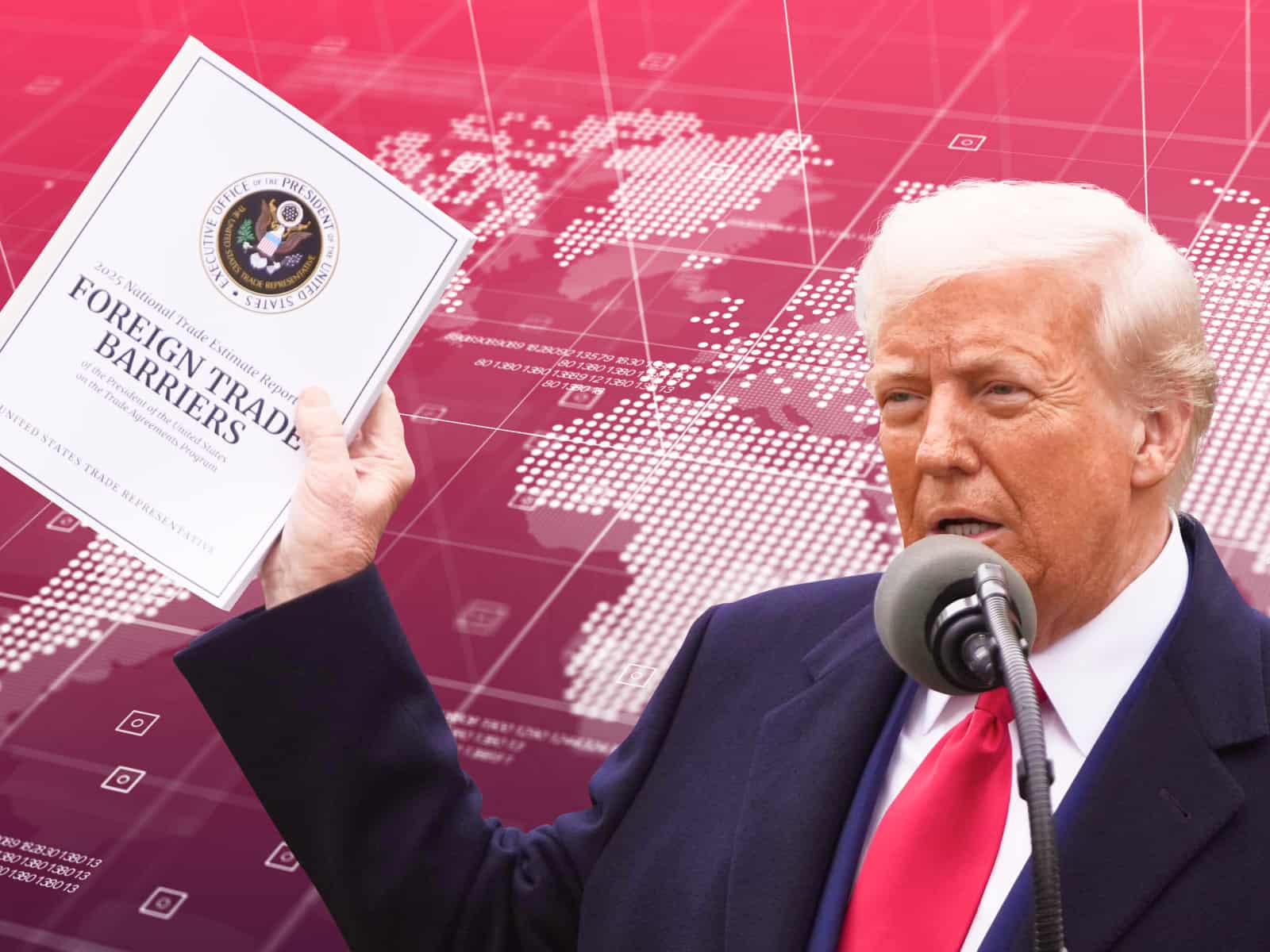




The US Supreme Court ruling rejecting the tariffs imposed by President Donald Trump brings a key issue for the world of finance back to the forefront of public debate: the link between economic and political dynamics and investments, and the ability to distinguish between noise and underlying signals. In this article, published in our Strategic Asset Allocation 2026, we explore recent developments in global trade and the lessons we can learn for investing.
In the 1930s, at the height of the Great Depression, an unprecedented protectionist spiral devastated global trade. It all began in the United States, when Congress decided to respond to the economic crisis by imposing tariffs on hundreds of consumer goods in an attempt to protect domestic farmers and industry. What was meant to be a defensive measure quickly became a global detonator. The tariff hikes triggered equally rapid retaliations from more than twenty countries. In just a few years, the international trading system imploded: between 1929 and 1934, world trade collapsed by around 65%. Trade between the United States and Europe shrank by almost two-thirds in just three years.
That trade war was not an isolated event, but a powerful amplifier of an already unfolding economic crisis. It contributed to bank failures, factory closures, and a further deterioration in social conditions. In many countries, that climate of impoverishment and disillusion created fertile ground for the rise of authoritarian and totalitarian regimes, with consequences that shaped the entire course of the twentieth century. This is why, after that traumatic experience, the world did not witness comparable upheavals in the global trading regime for nearly a century.
In the post–World War II era, tariff policy followed a clear and consistent direction: fewer barriers, more trade. This was driven not only by the memory of the mistakes of the 1930s but also by a deeply rooted idea in classical economic thought – that labour specialisation and free trade are essential engines of growth. Over the last seventy years, despite setbacks along the way, tariff barriers gradually decreased, helping to build the globalised world we know today.
2025 was supposed to be year zero for global trade
All of this held true until now. Expectations were that 2025 would mark the “year zero” of global trade policy: the beginning of a decisive turn toward protectionism, driven by Donald Trump’s return to the White House with a promise to finally deliver on his vision of a more isolated America, both commercially and politically.
It must be said that the intention was certainly there. In April 2025, speaking from the White House Rose Garden, Trump unveiled a new wave of tariffs, holding up a chart outlining a not-entirely-linear “reciprocity” principle. The tariffs targeted a substantial number of countries, including the United States’ three largest trading partners (Canada, China, and Mexico) as well as the European Union. On paper, the approach looked exactly like what many had feared. In fact, when writing this document in 2024, we had identified this as the highest-risk scenario: a unilateral move with the potential to destabilise global markets and ignite a spiral of uncertainty and retaliation.
Reality, however, proved far less catastrophic than expected. The global trade crisis everyone feared simply did not materialise, even before the Supreme Court ruling of February 2026. On the contrary, international trade continued to grow, reaching new all-time highs. According to a United Nations report, in the first half of 2025 global trade increased by roughly $500 billion and, barring surprises in the final months, 2025 is expected to close above the record set in 2024. Even relative to global GDP, trade has shown no signs of structural decline. Its share has stabilised at high levels in recent years – more an indication of equilibrium than of reversal. In other words, there was no collapse: global trade kept expanding despite tariffs and political tensions.
A system capable of reorganising itself
How do we explain this seemingly incredible gap between predictions and reality? Was the tariff risk a collective hallucination, or have the effects simply not yet emerged?
The truth is that the global economy is a complex system: it reacts, evolves, and develops self-correcting mechanisms. We believe that the damage remained limited largely thanks to the adaptive capacity of businesses and governments, which reacted quickly to the new environment. Rather than halting trade, companies reorganised their supply chains. Since the first wave of Trump-era tariffs – and later the pandemic, which exposed the system’s vulnerabilities – many firms have been realigning supply chains and making them more resilient. As a result, global value chains have proved far more flexible and robust than many had anticipated.
Political responses also played a crucial role. While Washington raised tariffs, most other countries – representing around 85% of global trade – continued abiding by existing rules and refrained from mirroring US measures. Except for China, which retaliated proportionally, almost no major economy adopted a hardline stance. Instead of a protectionist “everyone against everyone”, most of the world chose to keep trade channels open and stay at the negotiating table, seeking new balances and opportunities.
Emerging economies, from China to India, weathered the shock better than expected. Countries such as Brazil and South Africa strengthened ties with other markets to offset potential losses in US exports. At the same time, trade among developing nations – for instance within the BRICS bloc (Brazil, Russia, India, China and South Africa) – has been rising, creating alternative channels that act as buffers against tariff shocks from advanced economies.
More broadly, nearly all countries, both emerging and developed, recognised the need to reduce dependence on any single partner – whether the US or China – and began actively exploring “third markets”. Chinese exports to the US did fall in some sectors, but China compensated by expanding its exports to Southeast Asia, Africa, and other emerging markets. Countries like Vietnam and Mexico, initially seen as vulnerable due to high exposure to the US, responded with targeted economic policies and infrastructure investment, boosting competitiveness and attracting relocated production.
This does not mean trade tensions have had no negative effects. They have – but these effects have been localised and sector-specific rather than systemic. Industries heavily reliant on tariffed imports faced higher costs and shrinking margins; sectors such as automotive and electronics saw reduced competitiveness in some domestic plants. Agricultural regions oriented toward Chinese demand or industrial districts deeply integrated into the US – China supply chains suffered more than others. And this adjustment is far from over. The global trading system will continue to evolve in an environment of higher tariffs; the end of 2025 is not an endpoint but another stage in a longer transition.
However, at the global macro level, these frictions did not trigger a chain reaction capable of derailing the system. Trade between many other country pairs continued unimpeded – and even grew – offsetting isolated bilateral declines.
The last push of multilateralism
Recent years have seen much talk about the crisis of globalisation and the end of multilateralism. While it’s true that a naïve, linear, hyper-optimistic view of globalisation is no longer credible, the multilateral system – kept alive by a diversity of actors beyond governments – has proven far more resilient than expected. This is positive news for investors operating in an increasingly conflictual global environment.
We are undeniably in a transitional phase. Tensions remain high, and the risk of fragmentation persists. But it is more reasonable to expect the multilateral model to be tested and reshaped rather than dismantled abruptly, as some predicted. In other words, globalisation is still alive – just evolving.
Recent geopolitical frictions have also triggered constructive responses, pushing governments to renegotiate and diversify their partnerships. Dozens of bilateral and regional trade agreements have been revived or signed after decades of gridlock, driven by the fear of losing opportunities in a more fragmented world. At the end of 2024, for example, the EU and Mercosur – the South American trade bloc – announced the conclusion of a free-trade agreement after more than twenty years of negotiations. Talks between the UK and India or between Brazil and China have similarly accelerated.
Meanwhile, major powers have shown more pragmatism than expected. The US and China, despite harsh rhetoric and selective measures, have avoided a full-scale tariff war, opting instead for contained skirmishes and tactical negotiations. The EU has pursued dialogue with Washington to manage disputes in specific industries. The general logic has been one of containment: managing conflict without disrupting critical trade flows or destabilising the global economy.
Additionally, globalisation continues under new forms. While trade in physical goods is growing more slowly, trade in services and digital flows is accelerating. In 2024, global trade in services – many delivered digitally – grew by around 7%, compared with just over 2% for goods. Cross-border data flows, from e-commerce transactions to cloud computing, continue to expand rapidly. This suggests that economic interdependence is increasingly rooted in digital connectivity and that political “deglobalisation” has not severed the ties binding firms globally.
Economic narrative vs economic reality
Ultimately, 2025 leaved us with a less bleak picture than many had anticipated: the great global trade crisis is the crisis that never happened. This doesn’t mean tensions have vanished. The environment remains fluid, marked by structural frictions, latent vulnerabilities, and numerous unresolved geopolitical and commercial issues. These could still slow global trade in the coming years.
At the same time, globalisation and multilateralism remain alive. Production networks, trade flows, and financial ties have not dissolved – they are being reshaped. What we are witnessing is not the end of globalisation but its reconfiguration.
Above all, this phase reminds us of the importance of moderation and perspective in economic judgment. In a world saturated with data, forecasts, and analysis – and with a natural human tendency to imagine worst-case scenarios – it is easy to overestimate shocks and underestimate the system’s resilience. This doesn’t mean ignoring risks, but recognising that economies can adapt far better than expected and that outcomes can turn out much better than feared.
For investors, this message is particularly relevant: distinguishing between noise and signal, between political rhetoric and economic fundamentals, can make the difference between reactive decisions and more thoughtful long-term choices.
This article is part of our new Strategic Asset Allocation, which sets out our long-term view on markets and informs the strategic positioning of the portfolios managed by our team on your behalf.
*As with all investing, financial instruments involve inherent risks, including loss of capital, market fluctuations and liquidity risk. Past performance is no guarantee of future results. It is important to consider your risk tolerance and investment objectives before proceeding.