




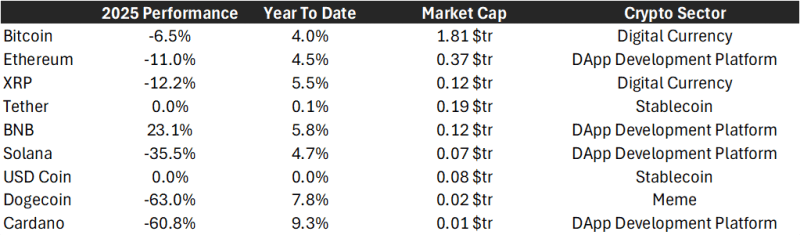
December 2025 concluded a year that ultimately trailed market consensus for cryptocurrencies. Although negative year-over-year returns are not unusual for high-volatility asset classes such as Bitcoin and Ethereum, the overall sentiment was one of missed opportunity and underperformance relative to prevailing expectations.
The narrative throughout much of the year had centered on the burgeoning maturity and resilience of the digital asset sector, but the end-of-year figures suggested this promised stability had not yet materialized in a meaningful way.
The most perplexing aspect of this downturn was that the macro backdrop was, in theory, remarkably favourable for decentralised assets – digital assets that operate independently of central banks and traditional financial intermediaries. A confluence of significant global events and political shifts were widely anticipated to solidify Bitcoin’s narrative as a “digital gold” and a new symbol of stability and independence from traditional financial systems.
Specifically, the geopolitical landscape, marked by escalating tensions in key global hot spots, typically drives capital toward safe-haven assets. Furthermore, the anticipated Trump presidency, coupled with structural tension on the Federal Reserve (Fed) and persistent dollar weakness, should have collectively acted as a powerful tailwind for assets operating outside central bank control. These factors, many argued, should have cemented the role of Bitcoin as an essential hedge against currency devaluation and systemic risk.
However, this expected flight to decentralized safety did not play out. The spotlight was conspicuously taken by traditional precious metals such as gold and silver. Gold, in particular, delivered a robust performance, underscoring its enduring status as the preeminent global store of value. This market dynamic led to a striking reversal of the popular “Bitcoin is replacing gold” thesis. As one observer aptly summarized, rather than Bitcoin successfully usurping gold’s millennia-old role, the market’s behavior suggested the inverse was true: “Gold is the new Bitcoin.”
This sentiment highlights a crucial divergence: while digital asset enthusiasts championed Bitcoin’s scarcity and decentralized nature, global capital, facing uncertainty, overwhelmingly opted for the proven liquidity, deep market history, and universal acceptance of physical precious metals.
The flows
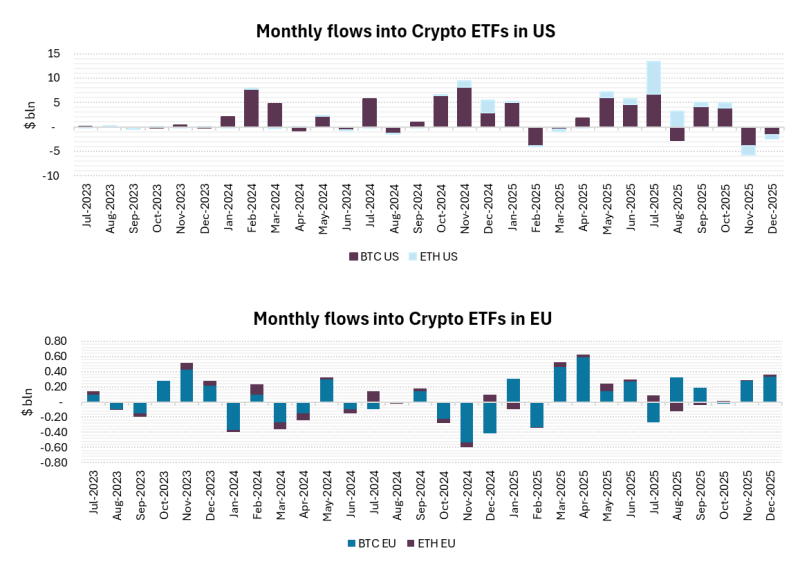
Overall, market activity for cryptocurrency Exchange-Traded Products (ETPs) – investment instruments that track the price of crypto assets and trade on stock exchanges – remained notably subdued throughout the period. This quietness was observable across all major geographical regions and product types, signaling a broader cautious or consolidation phase among investors.
The most significant directional trend observed was a persistent, albeit moderating, withdrawal of capital from US-listed crypto products. This marks the second consecutive month where the US market has registered net outflows.
The consistent selling pressure in the US suggests that earlier enthusiasm, possibly linked to specific product launches or price movements, has waned, with some investors opting to de-risk or realize profits.
In contrast, the European ETP market continued to demonstrate a degree of resilience. While not seeing a significant surge in new capital, the region successfully avoided the sustained net outflows seen in the US. However, it is crucial to note that while resilient, the absolute volume of flows into the European region remains marginal when compared to the global ETP market’s overall scale and liquidity.
Therefore, while providing a psychological counterbalance, Europe’s contribution is not sufficient to offset the larger negative movements elsewhere.
The macro picture
In 2026, we anticipate sustained global growth, driven by additional interest rate reductions, improving leading indicators, and a renewed acceleration of the US business cycle, avoiding a recession. This favourable macroeconomic environment, coupled with increasing global liquidity, a structurally weaker US dollar, and varied institutional interest, suggests Bitcoin is currently undervalued. As a result, we do not expect further major declines unless there is a sharp shift in market sentiment around global trade or new, heightened concerns about quantum computing posing a risk to Bitcoin’s security.
Blockchain data indicates the market may be reaching a period of stabilisation. Key metrics such as Percent Supply in Profit, Value Lost, and Unrealised Loss all point to this process. While this phase may still evolve, the current picture suggests that the market is unlikely to deteriorate significantly further. Critically, the market is entering this phase from a position of comparative structural strength relative to prior cycles. Furthermore, recent strong accumulation indicates that many investors view current price levels as representing good value.
The decline to date has been significant relative to other asset classes, but remains modest when compared with previous winter periods for this asset class. At the same time, flows and on-chain dynamics are showing patterns consistent with past bottoming phases, which supports our constructive view that the current environment could provide a solid foundation for the asset class’s further development.
Investing in Crypto involves a high level of risk. You should not invest unless you are prepared to lose all of the money you invest. The value of your Moneyfarm portfolio can go down as well as up, and you may get back less than you invest. You may not be protected if something goes wrong. Past performance is not a reliable indicator of future results. The views expressed here do not constitute a recommendation, advice or forecast. If you are unsure whether investing is right for you, please seek independent financial advice.
*As with all investing, financial instruments involve inherent risks, including loss of capital, market fluctuations and liquidity risk. Past performance is no guarantee of future results. It is important to consider your risk tolerance and investment objectives before proceeding.