






“I think things are going to take a downward turn, so I’m going to wait until the news settles before I invest.”
“I’m just waiting for the dip so I can buy low.”
“I want to move my investments to cash just to protect myself until there’s a correction – then I’ll jump back in.”
As a Wealth Manager, I hear these comments daily. They represent a natural human instinct, the desire to outsmart the system and ‘time’ the market. In theory, it’s the holy grail of finance: buy at the bottom, sell at the peak. In practice? It is one of the most expensive mistakes an investor can make.
Now, there’s a lot to unpick with these comments and this article aims to delve into the nitty gritty of timing the market and the drawbacks (sadly, there’s many) of attempting this virtually impossible strategy. We’ll look at what the research shows and the far more reliable strategy, time spent in the market.
Not once, but twice
Now, something often overlooked when speaking with clients about this idea of buying or selling at the ‘perfect’ time is that not only do you have to get it right once, but if you’re moving to lower risk/cash alternatives with the intention of re-investing that then means you now have to get it right twice. You have to nail the exit, and you have to nail the entry. This effectively doubles your chances of getting it wrong (and no, before you ask, this doesn’t double your chances of getting it right too).
In addition to this, the phenomenon of re-investing when things look ‘safe enough’ is on surface level a reasonable rationale, however, it is fundamentally flawed because it fails to recognise the underlying mechanics of how markets work.
To elaborate on what I mean, markets are forward looking. They don’t reflect how the world feels today; they reflect what investors expect the world to look like in six or twelve months. Historic market data has shown us again and again that by the time that ‘safe’ feeling finally arises in the news cycle, markets have already priced in the recovery and you’d likely be paying a premium well above what you would have lost by staying invested in the period just for ‘peace of mind’.
The Charles Schwab Corporation carried out some research looking at different investment strategies over 20 years. They concluded even the investor with ‘perfect’ timing for investments each year (timing the market) only marginally outperformed those who invested immediately (time in the market). Yet the cohort who had the ‘worst’ timing, significantly outperformed those who remained in cash waiting for that opportunity that for the most part would be luck based if you’d been successful.
What does this all mean? Well being frank, it means in theory it’s not impossible to outperform the market from exemplary timing, however the likelihood of that being you for a relatively insignificant reward is like weaving through heavy traffic constantly switching lanes to get one car ahead. You might feel like you’re moving faster, but you’re significantly increasing your risk of a crash just to arrive at your destination at best thirty seconds earlier.
The price of being wrong
We’ve looked at the reward for getting it right and hopefully, we can agree measly at most in the risk/reward trade off. But what about the costs of getting it wrong?
The research is overwhelming in showing the astronomically negative impacts that timing the market and getting it wrong (which is the significantly more likely event) can have on overall returns. The work done by Morgan Stanley is a prime example of how you can really rupture your investment growth from this risky investment strategy.
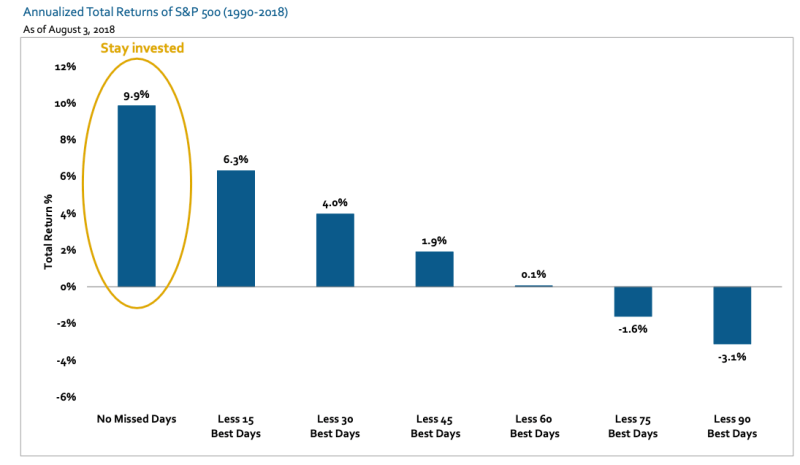
The chart shows results from investments in the S&P500 between 1990-2018, they found that investors who missed only the 15 best days in the market during the period had an annualised return of more than a third less than those who remained investors. Shockingly, investors who missed out on the 90 best days actually faced a negative 3.1% annual average return. Think about that: three decades of ‘waiting for the dip’ resulted in having less money than you started with, while those who ignored the noise built significant wealth.
What’s even more striking about this is that those ‘best days’ in the market for the most part were within 2 weeks of the ‘worst days’ – so again, if you’re trying to time the market you’re really playing with fire to try and avoid missing those golden days.
We’ve seen it all time and time again, think Covid in March 2020 – the market was rock bottom and the world in complete lockdown. If you’d have waited till things looked brighter and the medical breakthrough of the vaccine 12 months later, well you’d have missed out on one of the fastest recoveries in history. This is just one example of the same story which keeps coming back like groundhog day.. The headlines change yet the costly price of waiting remains the same.
In context
If you’re reading this, you’re likely familiar with the standard disclaimer that past performance is not a reliable indicator of future results, and that point stands unequivocally. Historical data, when used carefully, is intended only to provide context rather than prediction.
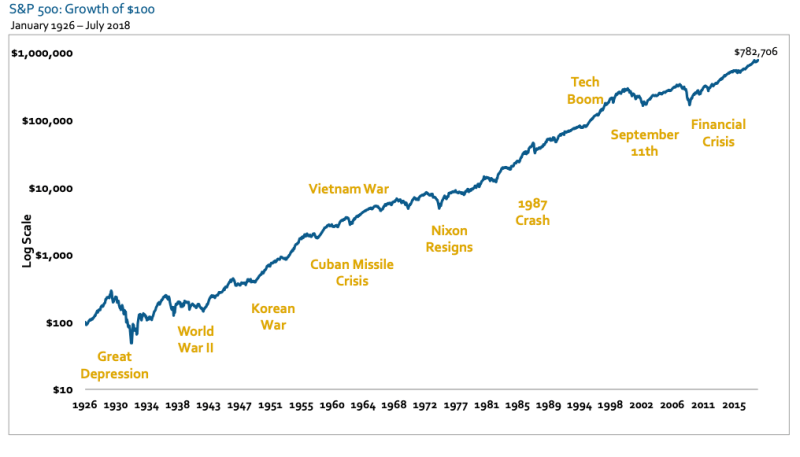
The world has endured incredible upheaval – from global conflicts to pandemics and systemic financial crashes. While markets of course are and were impacted by these events in the short term, history shows a consistent pattern of resilience. For those investing for the long term in a globally diversified portfolio, the noise of these events eventually fades into the background of a broader upward trend. Below is another chart from Morgan Stanley showing some of the key disruptive events over the years and the trajectory of the S&P500 throughout.
Bringing us to the core message of this article, time spent in the market is your greatest asset. In your 30s, 40s and 50s you have something more valuable than gold (yes, pun intended) – time. By attempting to time the market not only are you putting an immense amount of emotional pressure on yourself and risking your current capital, but you are risking the compounding power of the decades ahead.
As Warren Buffett once said “The stock market is a device for transferring money from the impatient to the patient” – investing should be for the long term and at Moneyfarm our strategy is built around a rigorous process which steps back from the daily market noise to evaluate the long-term potential of global asset classes.
Our goal is to move past short-term volatility and focus on the fundamental drivers of wealth: economic growth, inflation trends, and starting valuations. Looking at where markets are moving in the future, not what’s happening today which has already as we know been priced into the market.
Just remember, success isn’t about being right on the day – it’s about being present for the period.
Please remember that when investing, your capital is at risk. The value of your portfolio with Moneyfarm can go down as well as up and you may get back less than you invest. Past performance is not a reliable indicator of future performance. The views expressed here should not be taken as a recommendation, advice or forecast. If you are unsure investing is the right choice for you, please seek financial advice.
*As with all investing, financial instruments involve inherent risks, including loss of capital, market fluctuations and liquidity risk. Past performance is no guarantee of future results. It is important to consider your risk tolerance and investment objectives before proceeding.
