




As we do every month, our Senior Portfolio Manager and Head of Research, Roberto Rossignoli, takes stock of the cryptocurrency market. Bitcoin gained momentum in recent weeks as investors looked past geopolitical volatility and doubled down on institutional adoption trends.
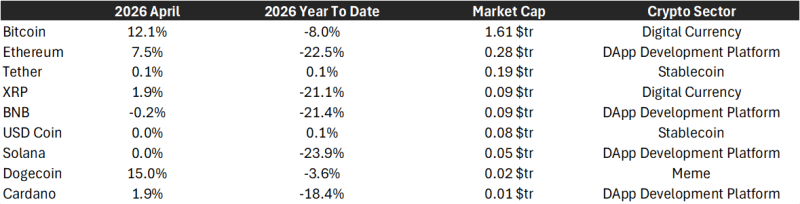
April delivered what the crypto market had been waiting for: Bitcoin gained 12% to close the month around $76,300, its best monthly performance since April 2025 and the second consecutive month in the green after five straight declines. Ethereum rose roughly 8% over the same window, also its strongest month since August 2025. Total crypto market capitalisation climbed approximately 10% to $2.7 trillion, extending the recovery that began with the March ceasefire.
In early May, the picture improved. Bitcoin broke cleanly above $80,000 in the first week, touching $82,400, its highest level since late January. By May 11, it opened at $82,164, the strongest opening since January 31. Ethereum traded around $2,370.
The Macro
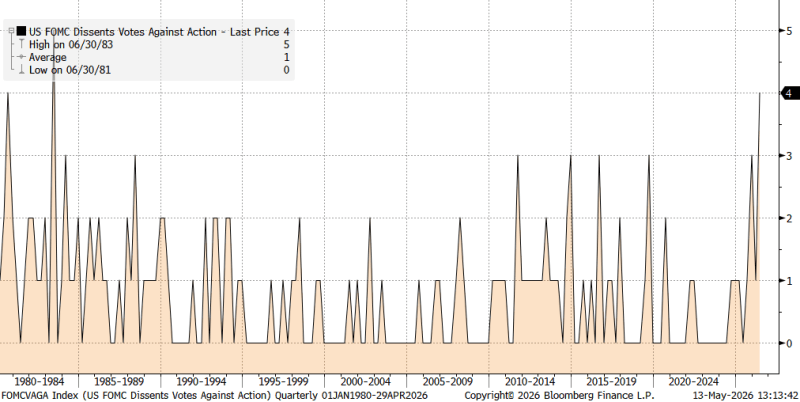
The macro backdrop remained hostage to the Iran-driven energy shock, which kept oil prices elevated and inflation expectations climbing. Monetary policy added a second layer of uncertainty: the Fed’s transition to Kevin Warsh as new chair is clouding forward guidance just as the committee’s historic 8–4 April split exposed deep internal disagreement over the rate path.
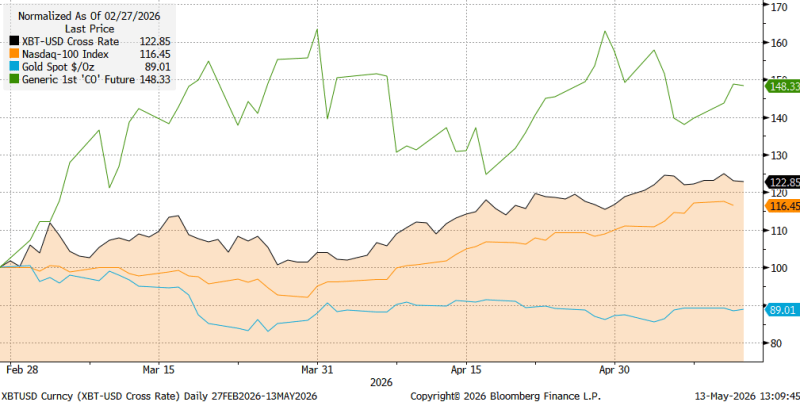
The Middle East conflict remained the dominant macro force. Oil prices stayed elevated, hovering around $103 per barrel in late April, spiking on headlines like the US seizure of three Iranian tankers. The ceasefire announced on April 7 provided temporary relief but proved fragile by early May, US President Donald Trump rejected Iran’s latest peace proposal as “totally unacceptable,” and the conflict returned to its role as a persistent source of energy inflation and risk compression. The dollar strengthened on safe-haven flows, treasury yields rose, and the familiar pattern reasserted itself: every oil spike pressured risk assets, and every diplomatic signal of de-escalation triggered a relief rally. Bitcoin and equities alike remained highly sensitive to the headline cycle.
The cross-asset picture in April was therefore more constructive than March, and Bitcoin benefited alongside other risky assets. The S&P 500 and Nasdaq rebounded from their March lows, and Bitcoin’s 12.7% gain meaningfully outperformed equities.
Gold remained under pressure as heightened rate volatility fed directly into the asset class. The same inflation shock that should have supported precious metals instead raised the prospect of higher-for-longer policy, leaving gold caught between its haven appeal and its sensitivity to real yields.
The Micro
The regulatory story accelerated through April and into May. The Securities and Exchange Commission (SEC) formally ended its regulation-by-enforcement approach to crypto, confirming a philosophical shift toward targeting fraud and manipulation rather than pursuing broad jurisdictional claims over tokens.
The CLARITY Act continued its path through Congress. On May 1, text emerged revealing the stablecoin yield compromise: crypto firms would be allowed to offer stablecoin rewards but prohibited from offering yield that is the functional equivalent of bank deposit interest. Still, Polymarket odds of passage in 2026 stood at 62%, down from nearly 80% after the stablecoin deal, partly due to renewed banking-sector lobbying and fragmentation in the republican cohort.
On-chain, the period was marked by a jarring contrast between institutional maturation and persistent security failures. Tokenised U.S. treasuries continued to grow, reaching their highest levels yet by April.
On the negative side, two developments are worth flagging. North Korean-affiliated hackers executed a brutal stretch in April, draining $285 million from Drift Protocol and $292 million from KelpDAO within 18 days, accounting for 76% of all crypto hack losses in 2026. Separately, Google’s Quantum AI group published a paper estimating that breaking Bitcoin’s elliptic-curve cryptography could require roughly 20× fewer resources than previously thought, compressing the timeline for a credible quantum threat. Neither is an immediate price driver, but both serve as reminders that the industry’s security assumptions, both on-chain and cryptographic, are under active pressure.
The flows
The flow picture in April was relatively strong, as buying activity seen in March persisted; the sentiment, alongside asset prices, is shifting a bit. Net inflows into spot Bitcoin ETFs crossed roughly $1.9 billion in April. BlackRock’s IBIT captured $1.7 billion of April’s flows alone, representing approximately 70% of total spot Bitcoin ETF inflows and reinforcing its dominance as the institutional vehicle of choice. Morgan Stanley’s MSBT was the standout new entrant. In its first month of trading (April 8 – May 7), the fund accumulated $193.6 million in cumulative net inflows and $239.6 million in net assets, with zero days of net outflows.
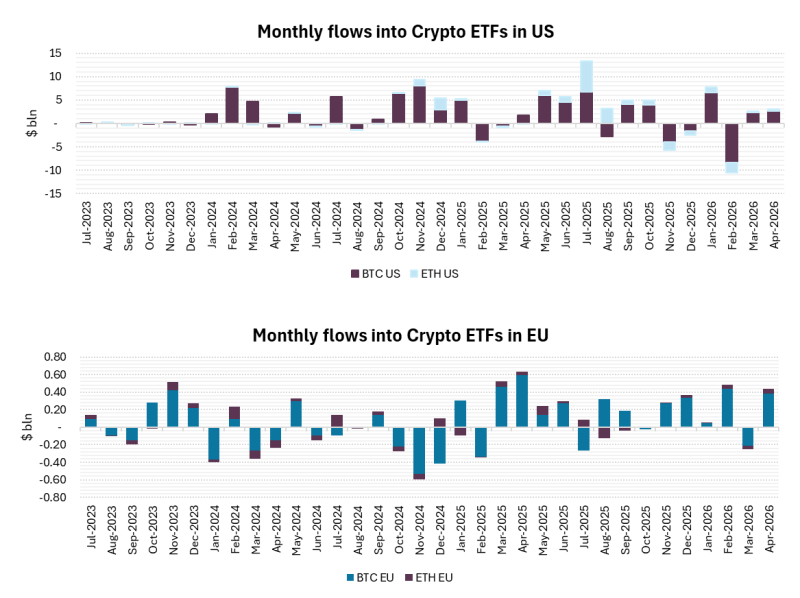
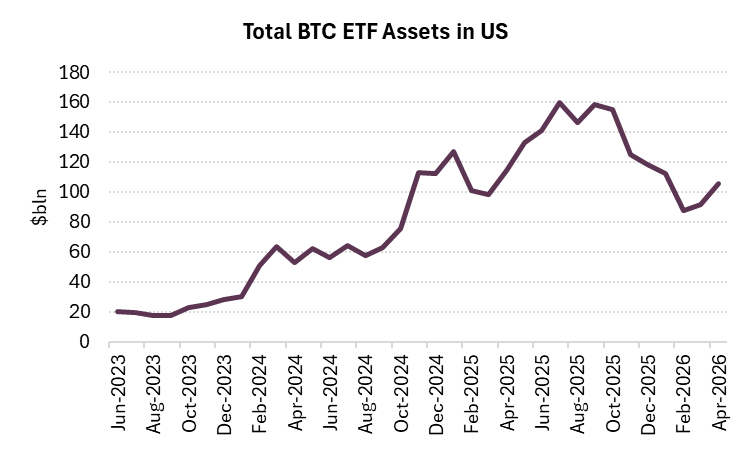
Total spot Bitcoin ETF net assets crossed back $100 billion for the first time since February 2025, with year-to-date inflows reaching approximately $4.9 billion. ETFs were absorbing an estimated 4,500 to 5,000 BTC per day while mining produced only 450, a 10:1 demand-to-supply ratio that, if sustained, creates a structural squeeze, also contributing to the positive performance.
Investing in Crypto involves a high level of risk. You should not invest unless you are prepared to lose all of the money you invest. The value of your Moneyfarm portfolio can go down as well as up, and you may get back less than you invest. You may not be protected if something goes wrong. Past performance is not a reliable indicator of future results. The views expressed here do not constitute a recommendation, advice or forecast. If you are unsure whether investing is right for you, please seek independent financial advice.
*As with all investing, financial instruments involve inherent risks, including loss of capital, market fluctuations and liquidity risk. Past performance is no guarantee of future results. It is important to consider your risk tolerance and investment objectives before proceeding.