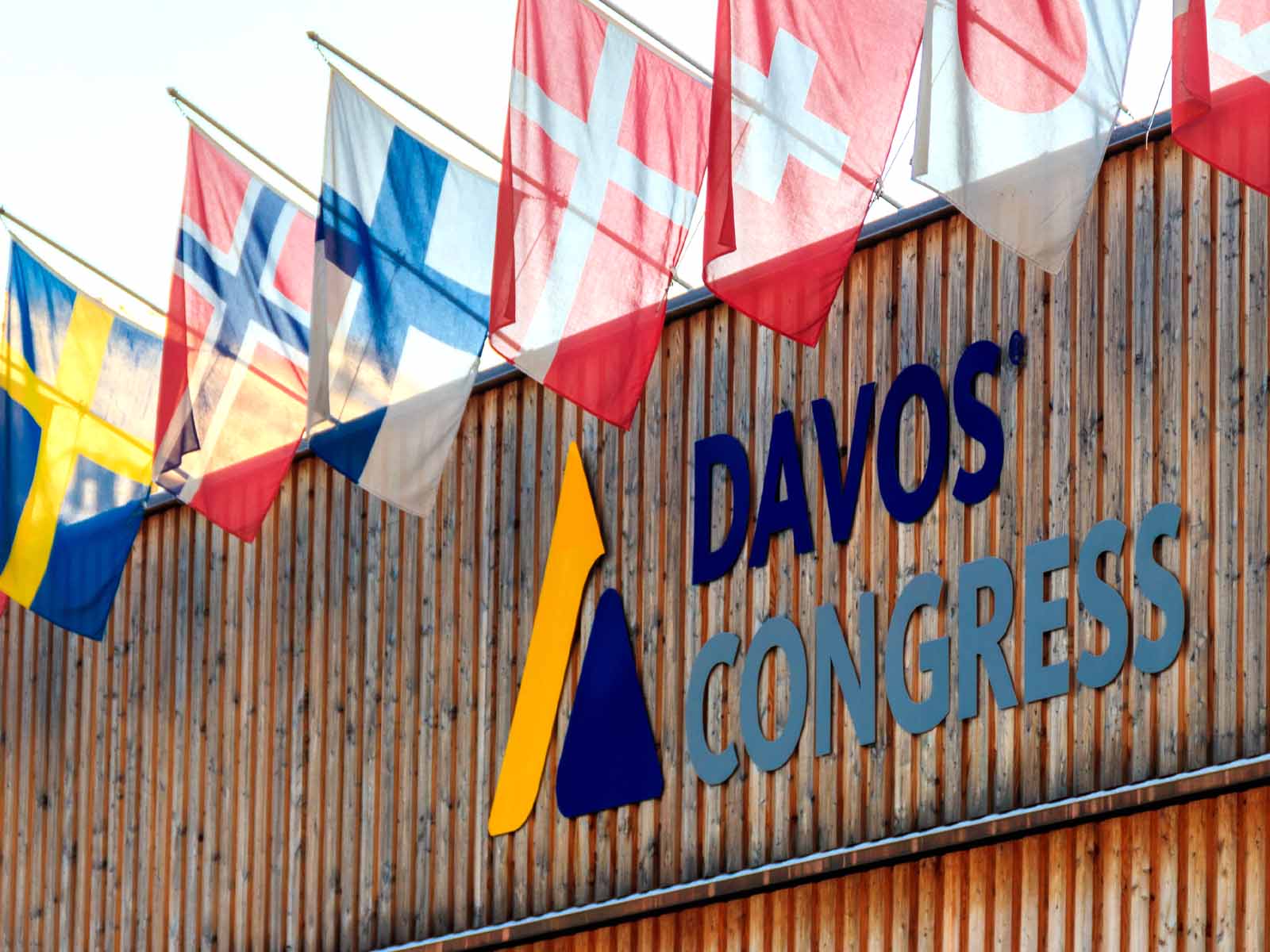


“A spirit of dialogue”: this was the theme that, with an explicitly hopeful note, the organisers chose for the 2026 edition of the World Economic Forum (WEF), also known as Davos. Global elites gathered in Switzerland this January amid a complex international backdrop, marked by rising tensions in the weeks leading up to the meeting and by multiple fronts of geopolitical instability, from Venezuela to the war in Ukraine.
On the cold Swiss mountains, it was the rhetoric of Donald Trump and his team that helped “melt the snow”. The President of the United States returned to Switzerland, commanding the spotlight at a forum more crowded than ever with global leaders: from Emmanuel Macron (sporting his aviator sunglasses) to Friedrich Merz, alongside Chinese Vice Premier He Lifeng, Canadian Prime Minister Mark Carney, Ukrainian President Volodymyr Zelensky, and European Commission President Ursula von der Leyen.
The proverbial optimism of Davos gave way this year to a stark portrayal of intensifying competition between geopolitical blocs.
Yet Davos remains a barometer of elite thinking, and amid the noise of disagreement there were no shortage of attempts to chart a way forward. Over the course of five days, discussions generated a wealth of insights and tackled issues of real substance. Despite being described by some as an event in decline, Davos continues to serve as a reference point for understanding how global economic and financial decision-makers see the world.
With the benefit of hindsight, we therefore attempt to analyse some of the debates that emerged, to better understand the worldview taking shape from the summit of the so-called Magic Mountain.
The geopolitics of middle powers
Geopolitics dominated the narrative and captured the attention of both participants and the media. The WEF’s Global Risks Report 2026 documents a shift towards an “era of competition” in global affairs, characterised by the erosion of cooperation and a collapse in trust. In the language of Davos, multilateralism is giving way to multipolar rivalry.
In this context, the speech delivered by Canadian Prime Minister Mark Carney attracted significant attention. He argued that so-called “middle powers” – a geopolitical grouping often overlooked in mainstream narratives, which could include European states and the United Kingdom – must work towards new forms of cooperation to compensate for the crisis of a system previously underpinned by the great powers.
The message struck a chord. The transatlantic relationship, which for eighty years has been a cornerstone of Western stability, showed clear signs of strain at Davos. European leaders privately expressed frustration over a number of unilateral moves by Washington. What should have been a unified Western front on issues such as Ukraine became more fragmented, as new divisions emerged.
Meanwhile, voices from Asia, Africa and the Middle East played an increasingly prominent role, seeking legitimacy and influence in forums once dominated by the elite of the old world.
Middle powers are finding a new voice, pursuing policies of “strategic autonomy”. Leaders spoke of strengthening regional forums and thematic alliances to fill the vacuum left by paralysed global institutions. India, for example, promoted at Davos a network of flexible mini-alliances to address energy security and critical value chains – an idea supported by Indonesia and Brazil.
Just days after the forum, Carney surprised many by endorsing a “new green trade pact” among middle powers, even floating the possibility of a bilateral free trade agreement with China focused on low-emission technologies.
In the corridors of Davos, it was widely accepted that no single superpower – nor a small group such as the G7 – can single-handedly steer the global agenda. Fragmented as the world of 2026 may appear, there is a shared view that multilateral engagement must continue in different forms. This is undoubtedly a positive development, offering at least a partial counterbalance to the narrative of global fragmentation.
Economic fundamentals remain solid
Despite geopolitical fractures, the global economy delivered a few pleasant surprises that helped soften the icy atmosphere in Davos. Kristalina Georgieva, Managing Director of the International Monetary Fund, noted that global growth has remained resilient, with expansion projected at around 3.3% in 2026 – defying recession fears that dominated the outlook just a year ago.
Consumer spending has held up across major economies. Georgieva described this resilience as “the biggest surprise” of the past twelve months. She was quick, however, to warn against complacency: “Uncertainty is the new normal,” she said, urging leaders to build buffers, diversify value chains and strengthen financial safety margins.
This caution appeared well founded, given the economic fault lines highlighted at the forum. Geoeconomic fragmentation topped the list of short-term risks in the WEF survey, overtaking even inflation and conflict.
The spectre of a major decoupling – the progressive separation of previously interdependent economies, involving rival trade blocs, technological bifurcation and financial disengagement – loomed large over many discussions.
Yet an encouraging reality also emerged: a full-blown “economic war” has so far been avoided. Trade tensions have not materialised to the extent feared. Agreements, exemptions and adjustments have helped avert retaliatory spirals, keeping trade flows open despite political frictions. This has prevented a return to 1930s-style protectionism.
Instead, global trade has quietly restructured itself. Intra-regional trade has increased, and certain regions – notably Southeast Asia and India – are emerging as new engines of growth.
That said, macroeconomic risks remain. Central bank governors meeting in Davos expressed concern over the lagged effects of restrictive monetary policy and persistently high debt levels. Business leaders spoke of “localisation” and “friend-shoring” as strategies to reduce exposure to geopolitical shocks. A WEF report even suggested that companies should strengthen their “geopolitical forecasting capabilities” within operating models, making navigation of a fragmented world a core part of corporate strategy. Despite economic resilience, the macro outlook for 2026 therefore remains mixed.
Artificial intelligence and technology: from hype to execution
Few topics animated Davos 2026 as much as advances in Artificial Intelligence (AI). Unlike previous years, however, the tone was markedly more pragmatic. After a phase of near-frenzied enthusiasm, AI is entering a more demanding stage, focused on concrete implementation.
Leading tech CEOs offered sober assessments of the challenges ahead. Microsoft CEO Satya Nadella addressed concerns around an “AI bubble”, stressing that sustainable growth will depend on transforming processes and productivity across non-tech sectors as well.
Nvidia CEO Jensen Huang, by contrast, focused on structural constraints. “AI is infrastructure,” he reiterated, arguing that success will hinge on investment in the physical systems that make it possible – from energy and computing power to skilled labour and manufacturing capacity. The next real bottlenecks for AI, he added, will not be algorithmic but related to the ability to deploy technologies at scale.
This more grounded perspective does not imply that optimism has faded. According to WEF surveys, effective and well-regulated AI adoption could boost global growth by nearly 0.8%.
Leaders are nonetheless acutely aware of the risks. WEF experts noted that “adverse effects of AI” – ranging from labour market disruption to security threats – have climbed rapidly among long-term global risks, entering the top five.
Climate and energy: a transition under strain
On climate change, Davos 2026 painted a picture marked by contradictions, with a few bright spots but many shadows. The latest WEF survey once again identified “failure of climate action” and extreme weather events as the leading long-term risks facing the planet. The cost of inaction continues to rise year after year.
Yet, as several leaders openly acknowledged, geopolitical and economic turbulence has frequently derailed the climate agenda.
Former US Vice President Al Gore captured this dilemma during a session, observing that in many countries climate policy is experiencing a “recession” just as the clean technology revolution accelerates. Politics, he argued, is lagging reality: too many governments remain captive to fossil fuel interests, producing “schizophrenic” swings – pledges of climate neutrality followed by new oil drilling.
Nevertheless, the energy transition continues. According to Gore, market forces and innovation are driving an unprecedented boom in clean energy. In 2025, 93% of new global electricity capacity came from renewable sources.
The real tension lies between this green momentum and the disorderly geopolitics of energy. The war in Ukraine and the resulting gas crisis have pushed many governments to reassess energy priorities, often at the expense of climate goals. In the United States, political alternation has had a profound impact: environmental policies championed by the previous administration are now facing a sharp reversal.
Meanwhile, developing countries arrived in Davos with clear demands: greater climate financing and assurances that they will not be forced to choose between energy access and low-emission development.
The crisis of democracy
One of the most unsettling threads running through the forum was the debate over declining trust in institutions and democracy. If Davos has traditionally been the conclave of the global establishment, the 2026 edition portrayed a system under strain – not so much from external challenges, but from growing public distrust of institutions and elites.
A series of surveys and public interventions during the forum gave substance to this perception. The Edelman Trust Barometer 2026, presented in Davos, revealed that nearly 70% of people in major countries are “reluctant to trust someone with different values or opinions”. A striking figure that quantifies the deepening polarisation fracturing societies.
This erosion of trust has tangible consequences. As confidence declines, so too does the collective capacity to address pressing challenges – from economic inequality and conflict to the climate crisis. Central bankers voiced concern over a “trust deficit” that weakens the effectiveness of communication around inflation and financial stability; numerous CEOs discussed the need to rebuild customer trust in an era marked by data misuse and AI-related abuses.
Among the most emblematic voices, BlackRock CEO Larry Fink warned that “the erosion of trust is being accelerated by the perception – often justified – that the benefits of growth accrue to an ever-smaller minority”. Without a serious commitment to reducing inequality, he cautioned, “the social contract risks breaking down completely”.
Delegates from emerging democracies echoed similar concerns, citing coups, widespread corruption and populist drift that are undermining democratic structures in various regions.
Ultimately, Davos 2026 made it clear that without renewing the trust pact, addressing other global priorities will become vastly more difficult. And, one might add with a hint of bitterness, the spectacle offered by some leaders in the luxury resorts of the Swiss Alps does little to bridge this divide.
*As with all investing, financial instruments involve inherent risks, including loss of capital, market fluctuations and liquidity risk. Past performance is no guarantee of future results. It is important to consider your risk tolerance and investment objectives before proceeding.