


In this special analysis, Daily Telegraph investment columnist David Stevenson turns to a subject on which everyone claims expertise: the dollar. From the foreign exchange dealing floors of London to street traders in the developing world, opinions abound. Yet the dollar often defies predictions – and at times even macroeconomic logic. It remains the world’s largest safe-haven asset, tied to an economy that both worries and excites in equal measure. Some argue that it is losing that status, though probably not as quickly as the dollar bears suggest.
As I write these words, one pound of sterling (the author’s currency) buys you $1.30 in dollars. One year ago to the day exactly (21st November 2024), one pound sterling bought you just $1.26. If I am brutally honest, that current rate surprised me. Surely, sterling should be weaker and the dollar stronger?
Bear in mind that the dollar benefits from what’s been called an exorbitant privilege: it’s the global reserve currency and is widely used in international trade. By comparison, poor old sterling represents an economy that is mired – currently – in economic gloom, with investors constantly threatening to sell UK government bonds. It’s also a small country outside any trading bloc, with a currency that makes up only a tiny share of most central bank reserves. So, you might presume that sterling has had a rough time while the dollar, powered by Artificial Intelligence (AI), should be powering ahead.
Far from it, in fact. Sterling has, in fact, strengthened over the last year, while the dollar has weakened despite all the AI excitement. Now, this won’t come as a surprise to all the macroeconomic “experts” who think the dollar will weaken, but it may come as a surprise to UK citizens mired in that gloom who might have assumed everyone was keen to sell their pounds and buy dollars.
My point is a simple one. The world of FX – foreign exchange, the global market where currencies are traded – is a mysterious one, and there’s nothing more mystifying to rational experts than the dollar. As we’ll see, FX rates and regimes are complex systems that sometimes defy logic and common sense. For every expert who says the dollar will weaken, I can find many more who will say it will strengthen as a safe haven currency. Everyone thinks they have found a rule that explains the dollar’s behaviour, but in my experience, most rules about the dollar are time-limited and of little explanatory value.
Some dollar basics
Let’s go back to basics and map out what we do know about the dollar and other currencies. Starting with a broad point: currencies are much less volatile than everyone believes. Take the GBP/USD cable rate – the exchange rate between sterling and the dollar. For most of the last ten years, this cable rate has traded between $1.15 and $1.40, implying a range of around 20%. Or, to take another example, the USD/euro rate over the past decade has also moved within a narrow band of roughly $0.80 to $1 – another tight range of about 20%. It’s only when we zoom out to a 50-year time frame that we see much more significant moves: the GBP USD rate has traded down from $2.41 in 1971 to its current level.
More broadly, long-term measures of US dollar volatility are consistently lower than those of the US equity market, for instance. The US dollar, tracked via the Dollar Index (we’ll look at this metric in more detail shortly), usually sees annualised volatility in the 7–10% range. At the same time, US equities, as captured by the VIX Index – a gauge of expected market volatility – typically exhibit volatility well above 15%, except during prolonged bull markets.
Exchange rates rarely move for a single reason. Economists often look at a range of signals – from interest-rate differentials to broader macro fundamentals – to understand shifts in currency pairs such as USD/GBP. What ultimately matters in FX markets is precisely these pairs: traders focus on them because that is what they trade, and for investors the implications are just as tangible. A stronger dollar and weaker pound, for instance, mechanically lift the value of US equity holdings for UK-based investors, and vice versa. Cross-border investment flows are themselves an important part of the global FX mosaic.
But investors are far from the dominant movers behind FX rates, which brings us to the next point: investors are far from the only people interested in a particular pair’s trade. There are plenty of non-investment participants in FX markets as well, including central banks, which may be compelled to hold currencies they would not necessarily choose – think of the People’s Bank of China (PBoC) and the dollars accumulated by Chinese exporters. More importantly, many financial and commercial institutions also operate in these markets: businesses that earn dollars through trade and seek stability in the exchange rate they depend on.
These players don’t always care about fundamentals and make academic analysis over the medium to long term very difficult. The most classic way macro economists look at currencies is through the prism of what are called fundamental metrics, i.e., whether a currency is under- or overvalued based on what it can buy or purchase. This is called the PPP (Purchasing Power Parity) method of valuing currencies, which compares what the same basket of goods costs in different countries – popularised by the Economist’s Big Mac Index, i.e., what a Big Mac costs around the world. As of this summer, the index indicates that the euro was around 36% overvalued against the dollar on a GDP-adjusted basis, while the pound was about 31% overvalued, implying that sterling should be weakening rather than strengthening. Which brings us back to the puzzle raised at the start: despite these signals, the pound has in fact appreciated over the past year. If one were to rely on the traditional framework economists often use to assess currency value, sterling should be moving in the opposite direction.
This PPP fundamental analysis can be useful and, over time, is probably somewhat predictive, but over the short term (the next 12 months), it has almost always been shown to have no predictive value. That’s because what moves the pound and the dollar is a myriad of forces and flows, only some of which are influenced by fundamental metrics.
And even when we are dealing with more fundamentally motivated players such as banks, other factors are at work, such as the dollar’s safe-haven status. At the beginning of this article, I mentioned the term exorbitant privilege, which was coined in the 1960s by Valéry Giscard d’Estaing, then Minister of Finance, who would later become president of France. He was describing how the dollar could float above financial realities because it was the global reserve and trading currency, allowing the country to run enormous deficits and keep interest rates low. One aspect of this is that the dollar is a safe-haven asset, i.e it’s liquid, easily accessible, and can be traded in an instant. That makes it a tremendous safe haven asset when times are tough.
This provides some rich ironies. Many of the most recent global economic wobbles have started in the United States, yet when markets lunge into turmoil, care to guess which currency investors pile into? You guessed it, the dollar. So, we have a situation where the US might be the cause of a panic, but the dollar is the safe haven for everyone worried about the ensuing panic.
Let’s take a concrete example. During the early days of the Global Financial Crisis (GFC), the US dollar initially weakened but then surged sharply as the crisis intensified, especially in the second half of 2008. From mid-2007 to mid-2008, the dollar depreciated by about 7% on a trade-weighted basis, reflecting concerns about the US subprime mortgage market and the vulnerability of US financial institutions. However, starting around July 2008 and especially following the collapse of Lehman Brothers in September, the dollar appreciated sharply – by about 13% against major currencies during the rest of 2008.
This prompts another point: TINA. Much as the Chinese central bank would love to use an alternative to the dollar – the Swiss franc, perhaps, or gold – There Is No Alternative (TINA). The Swiss Franc is almost certainly overvalued – by as much as 54% according to the Big Mac index – but there aren’t that many Swiss Francs in circulation, and most of them have already been snapped up by cautious central bank types.
The euro faces its own challenges related to long-term fiscal sustainability, as does the pound (our troubles are already noted). The Chinese government would love the renminbi to be a global trade alternative – and is working hard to make that happen – but in reality, it runs extensive capital controls, and the currency does not ‘freely’ float – if it did, it might appreciate sharply. So…TINA. Which in turn makes the dollar a safe-haven asset, which in turn affects the value of the dollar from time to time.
The dollar has been weakening
Up till now, we’ve emphasised the importance of FX pairs centred on the dollar. This can complicate any sensible analysis, as what drives one pair may be irrelevant to other pairs’ trade. Take the cable rate vs the Japanese yen/dollar trade. Both Japan and the UK have their fiscal problems. Still, Japan’s use of quantitative easing (QE) – where a central bank buys government bonds to keep borrowing costs low – and its currency interventions operate on a completely different scale from the UK’s. Japan’s government debt is more than 230% of the size of its economy, compared with less than 100% in the UK, which means Japan relies far more heavily on its central bank to help manage and finance that debt. Japan is a massive exporter with trade networks in both China and the US. The UK is much more European-focused by contrast. One can confidently predict a scenario in which the yen aggressively continues to devalue while the UK rights its fiscal position and sees sterling appreciate – as it has.
These dollar pairs all have their own drivers and catalysts, and we need to be very careful about generalising across lots of pairs’ trades. But that doesn’t mean we lack broader measures of the dollar’s strength against a basket of comparable currencies. One such gauge is the trade-weighted dollar index, or DXY, which tracks the dollar’s value against a group of major trading partners’ currencies, weighted by how much the US trades with each of them. As the chart below shows, the DXY has weakened over the past few months.
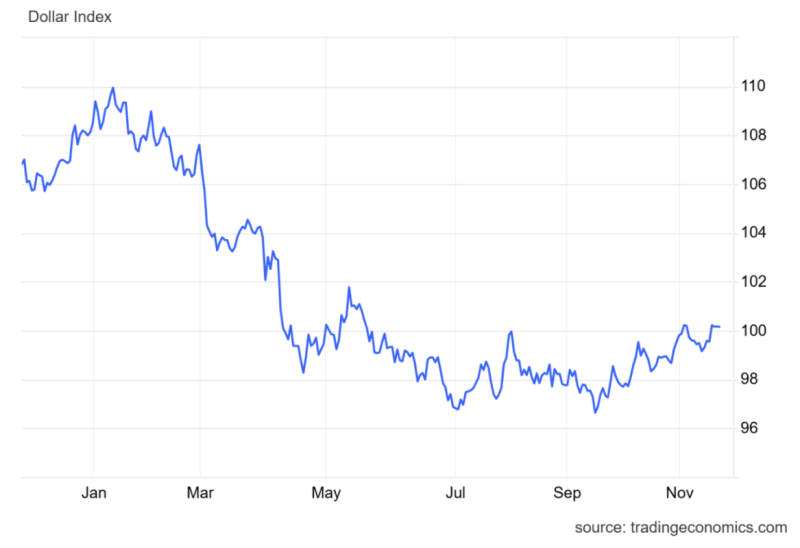
Politicians and economists like to fixate on the DXY, the dollar index, because it tells them whether the dollar is under- or overvalued against a basket of major traded pairs. A weaker dollar would make US exports cheaper. Unfortunately, it would also bump up the cost of their imports, adding to domestic inflation pressures.
Throughout the first half of 2025, the dollar fell by more than 12% on a trade-weighted basis (see chart above) amid uncertainty surrounding Trump’s second term as President and concerns that his threat of tariffs would damage global trade beyond repair. It’s also true that the dollar has been overvalued on most purchasing power parity metrics for some time, and history shows that currencies tend to mean-revert over the medium- to long term.
Switching to what might happen next, even before he took office, Trump was advocating for considerably lower interest rates. Whilst that is yet to materialise, concerns about the Federal Reserve (Fed) independence have weighed on sentiment and encouraged some to sell the dollar, helping currencies such as the pound strengthen over the last year. It’s also true that ballooning deficits have long had the potential to destabilise US debt markets. While the US has benefited from exorbitant privilege in recent decades, we are observing some momentum in attempting to erode the USD central role in the global economy, which remains an extremely long term and difficult goal
That said, the dollar is nowhere near as undervalued as it was at the start of the year. Consensus estimates for third quarter suggest the euro-dollar rate could reach $1.20, while the GBP-USD rate could reach $1.40.
| EURUSD | Q4 25 | Q1 26 | Q2 26 | Q3 26 |
| Median (Consensus) | 1.18 | 1.19 | 1.20 | 1.20 |
| Mean | 1.18 | 1.19 | 1.19 | 1.19 |
| High | 1.21 | 1.25 | 1.25 | 1.26 |
| Low | 1.15 | 1.13 | 1.11 | 1.10 |
| Forward | 1.16 | 1.17 | 1.17 | 1.18 |
| GBPUSD | Q4 25 | Q1 26 | Q2 26 | Q3 26 |
| Median (Consensus) | 1.34 | 1.35 | 1.37 | 1.37 |
| Mean | 1.35 | 1.36 | 1.36 | 1.36 |
| High | 1.39 | 1.42 | 1.44 | 1.43 |
| Low | 1.30 | 1.30 | 1.28 | 1.28 |
| Forward | 1.32 | 1.32 | 1.32 | 1.32 |
Dusting off the crystal ball
Looking further into the future, I’d be tempted to go along with a recent analysis by strategists at investment bank Goldman Sachs, in a recent paper entitled The dollar will not be replaced anytime soon, but it should still depreciate in which they declared that “even though there are few alternatives to the multiple roles that the dollar plays in the international financial system, we think dollar overvaluation will diminish as the US economy’s less exceptional performance makes it harder for the US to attract unhedged capital flows”.
The banks’ analysts see little evidence of global dedollarisation (traders and businesses abandoning the dollar). In reality, they argue that structural factors like the US share of global debt, GDP, and trade matter more for dollar internationalisation more than short-term financial swings – and inertia in currency choice typically means these changes are slow and often nonlinear. “The US’s shrinking share of global trade could gradually erode dollar dominance,” according to the paper, “but displacement appears to be a long way off. Meanwhile, the rise of dollar-pegged stablecoins and a lack of credible alternative global currencies should act as reinforcing mechanisms for the dollar’s current global standing.”
Still, they reckon that the dollar is poised to depreciate further in the coming months, because less exceptional economic and market performance no longer warrants its high valuation.
Then again, because really no one knows anything for sure about the dollar, these eminent investment bank strategists could be entirely wrong. The US could go haywire; the dollar could plunge or even shoot up in value. Remember: no one really knows anything for sure with the dollar except that everyone seems to keep using it.
What are the practical implications for investors in the UK and Europe more widely? I think the odds are greater that the dollar will weaken against the pound and the euro, which will be a headwind (though a small one) for those with extensive US dollar-denominated assets. A weaker dollar will also worry investors concerned about rising US inflation and who think US interest rates might not fall by much. By contrast, a weaker dollar is good news for US investors in UK and European shares (perhaps more M&A activity) and excellent news for US exporters.
Ultimately, currency markets remain unpredictable, and even the most seasoned analysts can be wide of the mark. For investors, the key is not trying to second-guess every twist in the dollar, but understanding how currency movements fit within their broader financial goals.
This article is for general information and market commentary only on foreign exchange (FX) trends and the US Dollar (USD). It does not constitute personalized financial or investment advice. The FX market is complex, and currency rates are subject to unpredictable changes and volatility. Commentary and forward-looking consensus estimates (e.g., Q3 2026 rates) are based on opinion and historical trends; they are not a guarantee of future currency performance. Do not act based on this information alone. If you are unsure you should consult a qualified and regulated financial adviser before making any investment decisions, particularly those involving foreign currency or cross-border assets.
*As with all investing, financial instruments involve inherent risks, including loss of capital, market fluctuations and liquidity risk. Past performance is no guarantee of future results. It is important to consider your risk tolerance and investment objectives before proceeding.