



The origins of a myth can sometimes be hard to trace. The myth of the dollar – today the world’s most widely used currency, a global brand, and in many ways a defining feature of the modern financial system – did not begin in the wooded islands at the mouth of the Hudson, nor among the manicured lawns of Philadelphia’s colonial mansions. Its roots lie instead in the snow-covered highlands of Central Europe.
Its ancestor was the Bohemian taler, a coin minted in the early 16th century, a period marked by significant monetary experimentation. The Counts of Schlick, in Bohemia, used newly discovered silver deposits in the valley of Joachim – named after Saint Joachim, the father of Mary – to issue a new coin. They called it the Joachimstaler Guldengroschen, the “great coin of Saint Joachim’s valley”. Through effective promotion, the Schlick family succeeded in spreading it along major trade routes of the time, from Flanders to the mouth of the Danube.
In everyday use, the lengthy name was soon shortened to taler, and as it moved across languages, taler evolved into dollar. For centuries, the coin acted as a kind of early European common currency. It is interesting to view this as a sort of origin story of globalisation, beginning not in major financial centres but in the mines and smelting workshops of a small Bohemian town.
In the United States, the dollar took its modern form in 1792, when Congress passed the Coinage Act and established a national currency for the young republic. This was more than an administrative decision: it was a symbolic step toward political and psychological independence from European powers. At the time, America used a patchwork of local and foreign currencies; the new dollar was designed to bring coherence to the system and to reinforce the authority of Alexander Hamilton, one of the Founding Fathers. The power to mint money is also the power to define value. Creating the dollar helped create trust – an essential foundation for creating a functioning government.
The dollar as a frontier epic
But the cultural emergence of the dollar cannot be traced to a legal decree alone. A currency gains significance by enduring, circulating, and being used in everyday life. The myth of the dollar took shape in the stories of the American frontier, in saloons where a silver coin could buy a horse, a night’s rest, or, in some cases, the chance to start over. In 19th-century accounts, the dollar travels westward with the pioneers: it rattles in stagecoaches, passes across gaming tables, and disappears into cloth bags hidden inside rifle cases. It becomes a unit of opportunity. In a country defined by the idea of unrealised potential, the dollar grows into the numerical symbol of that promise.
The coin becomes a constant reference point for a nation still forming its identity – an atmosphere later captured, among others, in Sergio Leone’s Dollars Trilogy. The dollar itself rarely appears on screen; it is more often implied, serving as the motive force behind characters’ actions. Money functions as a system of expectations: not only because it enables transactions, but because it conveys the possibility of something more. And in the vast, still-unsettled frontier, that sense of possibility needed a tangible form – a silver coin.
The dollars arrive
With the Bretton Woods agreements of 1944 (while the Second World War was still underway), the dollar became the cornerstone currency of the global economy and the main reserve and international exchange currency. Among other things, it was decided that the dollar would be the only currency directly convertible into gold and that all other currencies would have to fix their value by pegging themselves to the dollar.
The dollar would not become a global myth until after the Second World War, when it arrived in Europe alongside Camel cigarettes, soldiers’ rations, and shipments of Marshall Plan aid. As Italian film director and actor Vittorio De Sica wrote, recalling those years, “America was not a place: it was a smell of food and freedom”. And what is the dollar if not a scent of possibility?
Economists speak of “dollar dominance” and American hegemony, reading in those years the conclusion of sterling’s long decline as the world’s reserve currency. But beyond academic models, the phenomenon is measured in a simpler, more experiential way: the dollar is still the only currency no one refuses. In many parts of Africa, Asia and Latin America it circulates more widely than local currencies; it is the lingua franca of global markets, the currency the world uses when it does not know whom to trust.
A one-dollar bill might pass from the pockets of a tourist in Tokyo to those of a trader in Lagos, and on to the makeshift stall of a street vendor in Rio. And perhaps the defining paradox is this: the dollar holds its value precisely because it can be printed and reproduced. What makes it precious is not scarcity, but ubiquity – the infrastructure of power, trust, culture and military strength that sustains it.
A pop icon
From the post-war era onwards, the ground was ready for the dollar to assume symbolic and cultural dominance, upheld as much by American soft power as by its hard power. The currency became a dual object: financial infrastructure and pop icon.
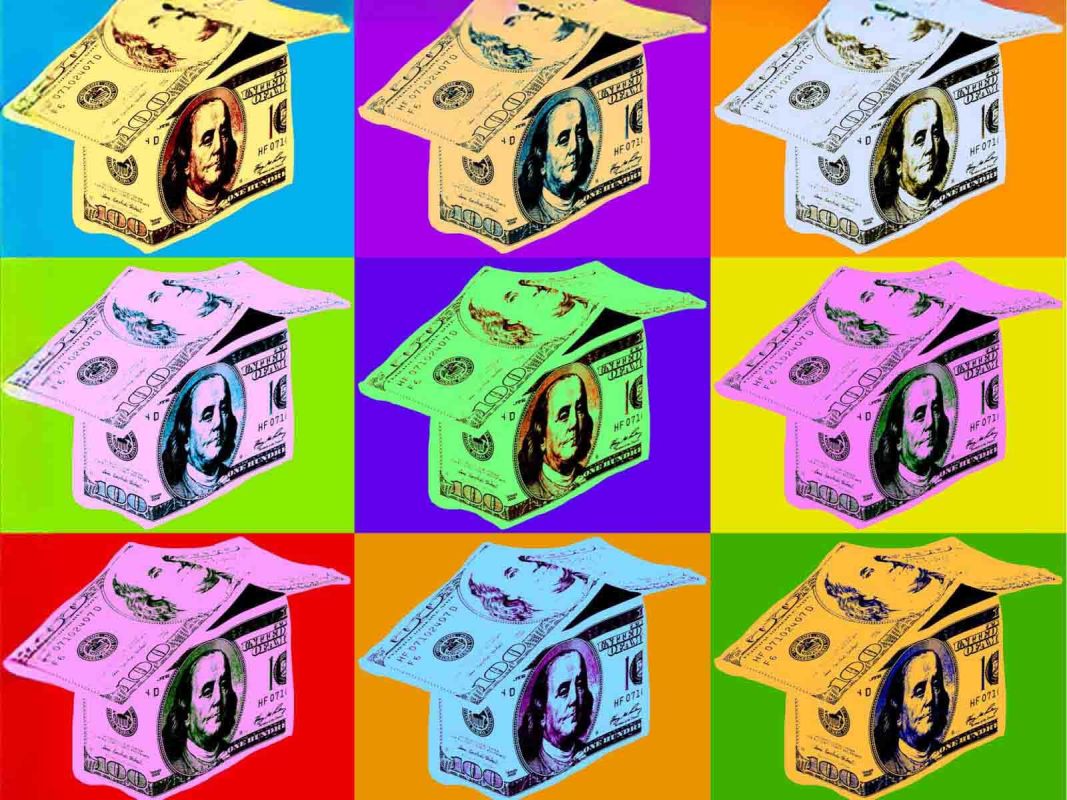
In the early 1980s, Andy Warhol cemented this transformation by dedicating a series of works to the “$” symbol. “Making money is art, and good business is the best art,” he later declared, making explicit the equation between creativity and capitalism. In his paintings, the dollar sign bursts in bright colours like those used for Marilyn Monroe or Elvis Presley, elevating money to the same status as American celebrities.
In Warhol’s hands, the dollar becomes a logo: the most recognisable in the West. Capitalism becomes aesthetics; consumption becomes a visual language; the dollar becomes a pop icon – playful, desirable, kitsch. Anonymous yet ubiquitous, democratic yet ruthless.
The dollar pulsing through capitalism’s veins
It was in the decades following the end of the gold standard – when the dollar was no longer convertible into gold – that the cultural image of the greenback evolved. As American consumerism expanded, the dollar became not just a medium of exchange but a powerful symbol of the country’s economic and social identity. During the 1980s, in particular, the dollar moved beyond its financial role and became part of a broader lifestyle, reflecting a period in which images and symbols gained unprecedented influence.
New York was the centre of this transformation. Capitalism adopted a new visual language and expressed it openly: the dollar was no longer only a tool but an aspiration. Popular culture amplified this shift. Films such as Scarface captured the intensity of the decade, portraying money as both ambition and status.
The dollar’s image permeated music, fashion, cinema and advertising. Its green colour became increasingly recognisable and ideologically charged. From the skyscrapers of Wall Street to the emerging hip-hop scene in the Bronx – where the “$” sign appeared in jewellery and clothing – the dollar strengthened its position as a cultural marker as well as an economic one.
Even today, though the tone is less celebratory than in the 1980s, the symbolic power of the dollar remains strong. Television and film continue to reference it in memorable ways: the piles of cash in Breaking Bad, or the Joker burning a stack of banknotes in The Dark Knight to highlight the emptiness of monetary motives. More recently, internet creators like Mr Beast have built massive audiences partly through videos centred on giving away large sums of money, reaffirming how deeply the dollar is embedded in contemporary visual culture.
In dollar we trust
Money is a narrative: a social construct before it is an economic tool. Aristotle had already understood this when he wrote that “money exists not by nature but by law”. A currency is a pure sign whose universal acceptance depends on a collective agreement sanctioned by the authority of the State.
After the end of the gold standard in 1971, this truth became self-evident. A banknote is, literally, “a piece of paper”, whose value is not guaranteed by precious metal but by the political and social consensus that underpins it. A dollar retains its value because millions of people believe in that value, and because the United States government guarantees it. Without trust, without political infrastructure, without power, even the greenback would lose its magic.
This is why, beyond cyclical fluctuations, the success of the dollar also rests on its imaginary value, accumulated over time and now inseparable from the military, economic and cultural power of the United States. The dollar embodies both the American dream and the geopolitical influence of a superpower. To hold a dollar is to hold not merely a currency, but a social pact: the promise that this piece of paper ultimately represents the interests and authority of the United States. On every banknote, almost consecrating this pact, stands the inscription “In God We Trust”. It may be true that some believe in God – but in the dollar, almost everyone believes.
Invest in US shares with Moneyfarm
Ready to tap the US market? We give you access to the US stock markets through DIY Investing via multiple products (Stocks&Shares ISA and GIA), with many advantages.
The value of investments can go down as well as up, and you may get back less than you invest. Past performance is not a reliable indicator of future results. Thematic investments (such as technology or AI-focused portfolios) may be more volatile and concentrated than a diversified portfolio. Returns from US investments may be affected by currency fluctuations. Nothing in this article should be taken as investment advice or a personal recommendation. Any views expressed are for information only and may change without notice. Tax treatment depends on your individual circumstances and may change in future. If you are unsure about the suitability of an investment, please seek independent financial advice.
*As with all investing, financial instruments involve inherent risks, including loss of capital, market fluctuations and liquidity risk. Past performance is no guarantee of future results. It is important to consider your risk tolerance and investment objectives before proceeding.